Best Data Certifications in the UK for 2026
The meeting that started this Google search
Somewhere in the last six months you've sat in a meeting where someone asked for "the dashboard". Or "the numbers". Or whether the team could "be more data-driven". And in that quiet moment, it sank in: the data game has stopped being optional. People who can read, manipulate, and explain data get the better roles now. People who can't, increasingly don't.
So you've started Googling. Best data certifications UK. Which one to do first. Whether you can actually get hired off the back of a foundation-level cert. The honest answers to those questions are more interesting than most blogs let on, so let's actually do the work.
Why this is happening to everyone right now
It isn't just you. UK companies have spent the last few years building data infrastructure they don't yet have enough people to operate. Almost every internal job board has a role with "data" in the title that nobody quite knows how to fill. At the same time, the BAs, project managers, ops leads and HR partners already inside the building are being quietly rewired into half-data roles whether they wanted to be or not. The dashboard meeting isn't a one-off. It's the new normal.
Which is, oddly, good news. The bar isn't "be a data scientist". The bar is "be useful in the room and credible in the next interview". A foundation-level data cert plus a year of poking at real datasets is genuinely the path most career movers take.
Most UK professionals adding data to their CV in 2026 aren't trying to become full-time data scientists. They're trying to make their existing role more durable, signal credibility for a small career move sideways or up, and stop nodding along through dashboard reviews they don't actually understand. That's a much easier brief than the cert websites make it look.
The honest framing before you pick one
There isn't a single "best" data cert in the UK. There are three that come up repeatedly in hiring filters, each opening a different door. Picking the right one is less about prestige and more about who you're trying to convince and what they'll actually recognise on a CV.
If you're in or aiming at the public sector, finance, or a UK consultancy, BCS opens doors that the others won't. If you're in or aiming at a Microsoft-shop business (most UK organisations are, whether they say so or not), DP-900 puts you on the Microsoft pathway. If you want a vendor-neutral credential that travels across whatever stack the next employer uses, CompTIA Data+ is the cleaner bet. Here's what each one is actually good for.
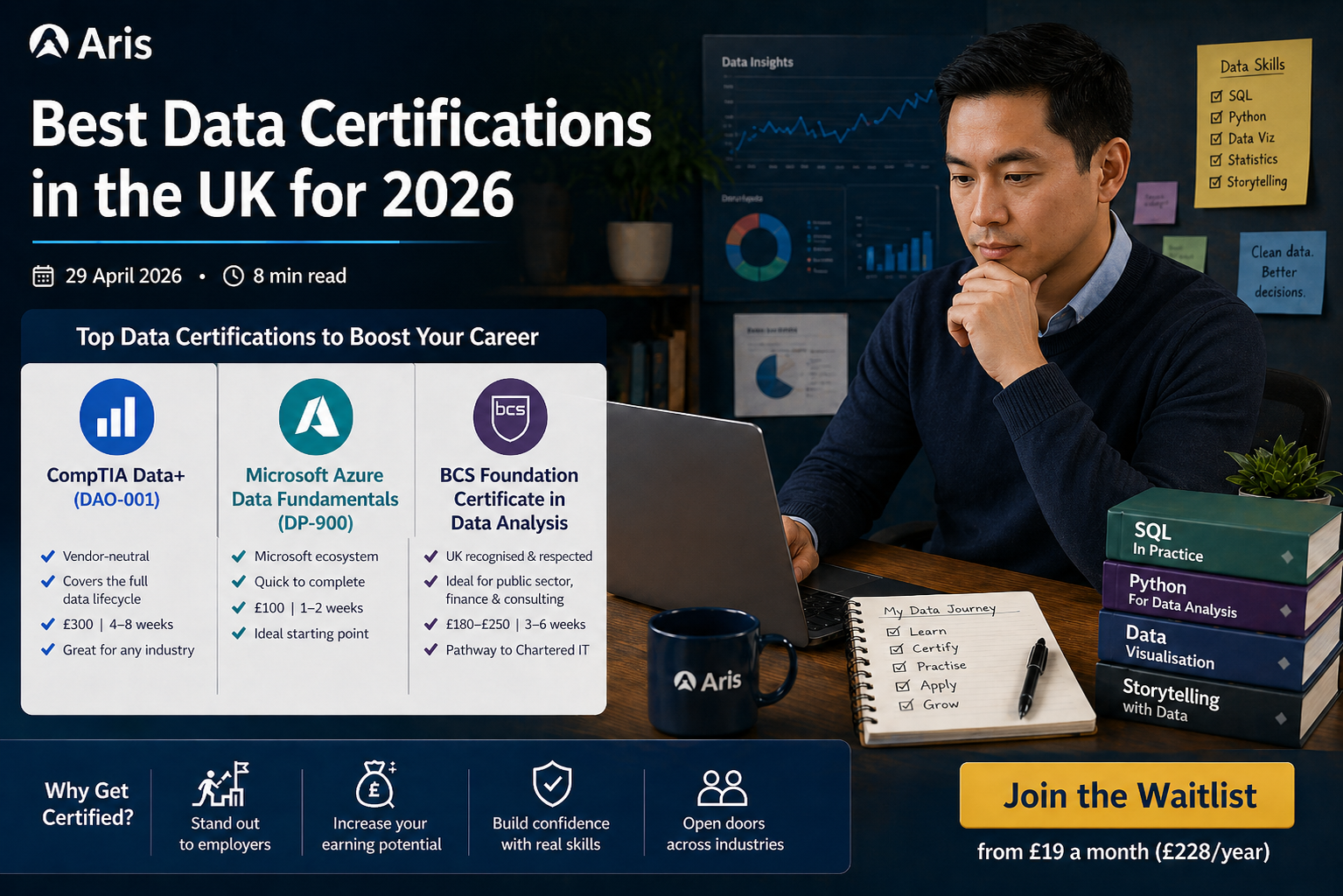
CompTIA Data+ (DA0-001). The vendor-neutral pick. Roughly £300, four to eight weeks of evening study. Covers data analytics, quality, visualisation, governance, and the whole data lifecycle without strapping you to one company's tools. CompTIA is already a fixture on UK job postings (Security+, Network+, A+ are everywhere), and Data+ is being added to the same shortlists as data teams mature. This is the cert to pick if you don't yet know whether your next employer will be on Microsoft, AWS, Google Cloud, or some chaotic mix of all three. The performance-based questions on the exam mean you actually have to think rather than just memorise.
Microsoft Azure Data Fundamentals (DP-900). The on-ramp. About £100, one to two weeks of focused study. Pure knowledge-based, no labs. Covers relational and non-relational data, analytics on Azure, and how the various services fit together. On its own, it won't land you a senior data role. What it will do is get "Microsoft Azure" onto your CV in a credible way and put you on the Microsoft Learn pathway, which is the most accessible certification ladder in tech. If you work somewhere that uses Microsoft 365 already (the answer is probably yes), this is the cert your IT and data colleagues already respect.
BCS Foundation Certificate in Data Analysis. The British one. £180–250, three to six weeks of study. BCS is The Chartered Institute for IT, the UK's professional body for computing, and their certifications carry serious weight in British government, financial services, and the big consultancies. If you're heading toward a public sector data role, a UK bank, or a tier-one consulting firm, BCS lands differently in the room than the American certs. It's also a proper stepping stone toward the BCS International Diploma in Business Analysis if you're building a chartered pathway over time.
If you've never touched data before
Start with DP-900. It's the cheapest, the fastest, and the lowest commitment. Two evenings a week for a fortnight and you've got a real cert with a recognisable brand on your CV. If you finish it and decide data isn't your thing, you've spent £100 and a couple of weeks finding that out. If it clicks, you've got the entry point onto the Microsoft data pathway and you're ready to layer on Data+ or BCS without having wasted the time.
The mistake most career changers make here is starting with the most prestigious-looking cert. CompTIA Data+ has more weight than DP-900, but if you're brand new to the field you'll spend three months studying for an exam where the foundations weren't laid yet. The faster, cheaper, smaller bet is the better first move.
If you're already pretty technical
Skip DP-900 and go straight to CompTIA Data+. If you've worked with spreadsheets, basic SQL, or any kind of dashboard tooling before, the DP-900 syllabus is going to feel obvious for the parts that count. Data+ is the cert that signals seriousness. It also doesn't tie you to a vendor, which matters if your next move could be into a non-Microsoft shop.
The other reason to skip DP-900 if you're already technical: hiring managers know what's foundation-level and what isn't. DP-900 is a good "I'm getting into this" signal. Data+ is closer to a "I can actually do this" signal. If you can clear the second bar honestly, do.
If you're heading into UK public sector, finance, or consulting
BCS, possibly stacked with one of the others over time. UK government and financial services hire on credentials, and the credentials they trust are local. Saying you have a BCS Foundation Certificate in Data Analysis lands differently in a Civil Service or Big Four interview than saying you have a CompTIA. CompTIA is fine. BCS is what they hire on. If you're already in those worlds and want to move into a data-adjacent role internally, BCS is the path of least resistance.
The data certs that get hyped on LinkedIn (Google Data Analytics Professional Certificate, IBM Data Analyst, and similar) aren't bad, but they're not what UK employers filter on for serious roles. They're useful for learning the material. They're not the cert that gets your CV through the door of a UK organisation that takes its hiring seriously. Pick from the three above and use the LinkedIn ones for supplementary learning if you want.
The bit nobody mentions: pairing data with what you already do
The strongest career move for most people considering a data cert isn't to become a "data person" outright. It's to pair data fluency with the role they already have. A project manager who can read and challenge dashboards. A Scrum Master who tracks team performance through real metrics rather than vibes. A BA who can clean a dataset before presenting it. A change manager who can model the impact of a transformation in numbers as well as in narratives. A security professional who can read threat data without flinching.
Each of those pairings is more valuable, and frankly more interesting, than another generalist data analyst. UK job board data suggests dual-credential professionals (PRINCE2 + Data+, or PSM I + DP-900, or Security+ + Data+) command meaningfully better offers than single-cert candidates. The combinations are where the moat is.
Where Aris fits in
The hard bit about adding a data cert isn't passing it. The hard bit is what comes after. The data conversations you'll have to hold in your next role. The interview where someone asks how you'd actually approach a messy dataset. The meeting where the senior leader wants the headline number, the underlying caveat, and your recommendation, all in 90 seconds.
That's the gap we built Aris to close. Aris teaches the certifications through real conversation, then walks you through voice-based simulations of the workplace situations data-adjacent roles actually involve. The dashboard review where the numbers don't add up. The stakeholder who wants you to make the data say something it doesn't. The interview question about a time you found a data quality issue and how you handled it. You practise the conversation, Aris scores you, then you do it again.
You don't strictly need Aris to make this work. You do need somewhere to bridge the gap between "I have the cert" and "I can hold my own in a data meeting". Wherever that practice happens, just make sure it happens before the next big meeting, not in it.
The honest takeaway
If you've never touched data before, get DP-900 and find out whether you like the field. If you're already technical and want a serious credential, get CompTIA Data+. If you're heading into UK public sector, finance, or consulting, get BCS. None of these are wrong. None of them is "best" in the abstract. The cert that's right for you is the one that opens the next door you actually want to walk through.
Build a portfolio of credentials employers actually hire for.
Study, practise, and advance with Aris.
Join the waitlistReferences
- CompTIA Data+ certification: comptia.org
- Azure DP-900 certification: learn.microsoft.com
- BCS Foundation Certificate in Data Analysis: bcs.org