Is APMG AgilePM Worth It in 2026? UK Salary Data, Costs, and Who It's For
The short answer
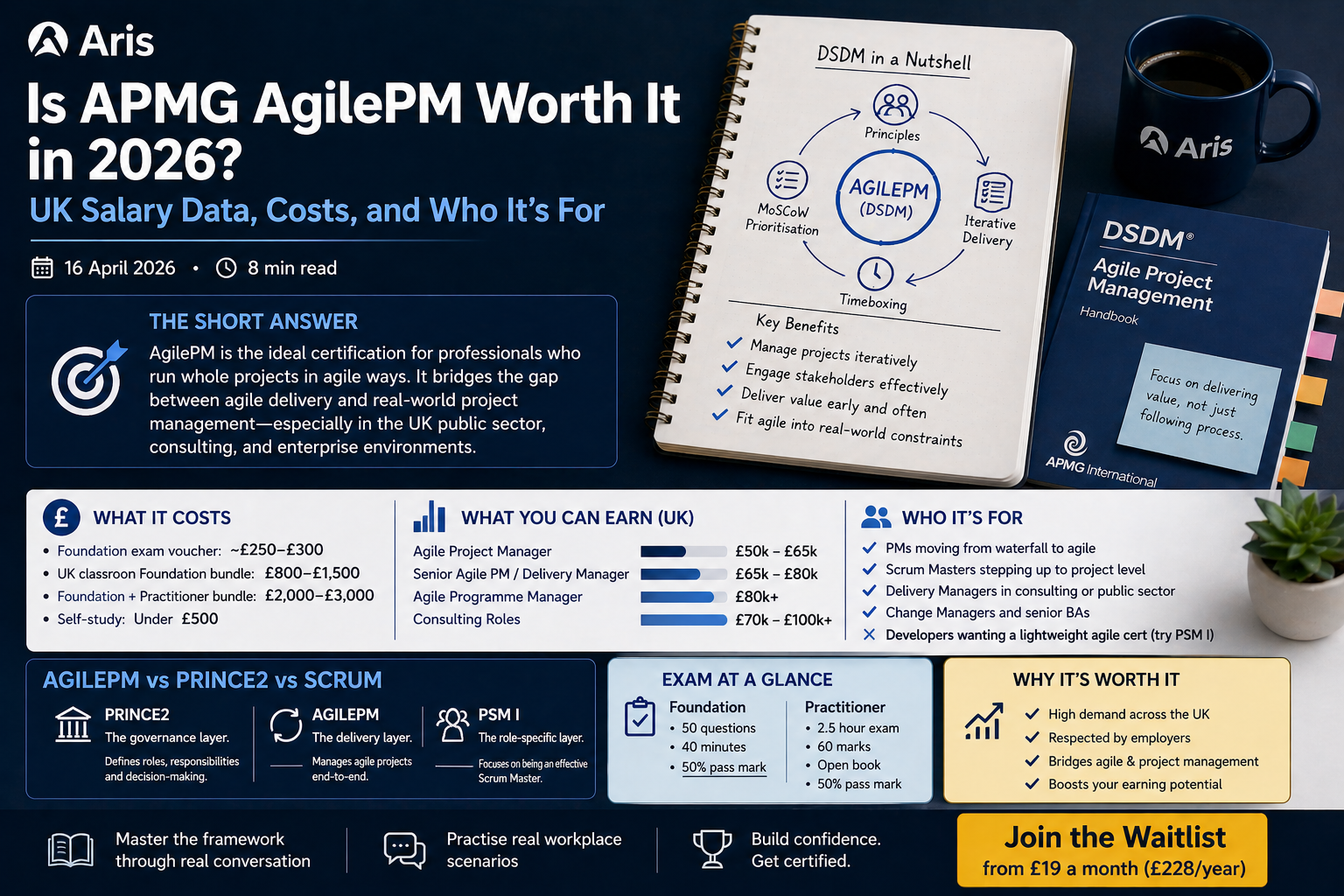
If you're the person who ends up running projects that are called "agile" but somehow still have a 40-page plan and a fixed go-live date, AgilePM is probably the cert you didn't know you needed. It's the one that actually takes the project layer of agile seriously, rather than pretending the project layer doesn't exist.
AgilePM is built on DSDM, the original agile framework designed for whole projects rather than single development teams. It's awarded by APMG International (same people who award PRINCE2), and it's a fixture in UK public sector, consulting, and enterprise delivery.
Here's the honest version though. If you're a developer on one Scrum team and you just want something to put on your CV, this isn't it. Go get PSM I instead. AgilePM is for the person running the whole thing. The one stakeholders go to when they want a straight answer about when it'll ship.
So what actually is AgilePM?
AgilePM stands for Agile Project Management, which isn't the most imaginative name but does exactly what it says. It's built on DSDM, a framework that's been around since 1994, which makes it older than Scrum. That detail matters more than it sounds. DSDM was designed from day one for running entire projects, not just managing a team's sprint backlog.
You get eight principles, a delivery lifecycle, defined team roles, and practical tools you'll actually use. MoSCoW prioritisation. Timeboxing. Facilitated workshops. Iterative builds. The stuff you reach for when someone asks "can we have everything by next quarter?" and you need to explain, politely, why the answer is no.
The thing AgilePM gets right is the bit most agile trainings skip: how to actually plan, control, and report on a project while still working iteratively. It's the difference between a team that's "doing agile" and a project that's actually delivering.
Who's using it in the UK (and who isn't)
Three places where you'll see AgilePM show up again and again:
- UK public sector. Government departments, local authorities, NHS digital teams. PRINCE2 is often mandatory for governance. AgilePM is how delivery teams add real agile on top without getting their hands slapped by audit.
- Consulting. The big four and the mid-tier UK firms use AgilePM heavily for transformation work. Clients want agile. Clients also want a Gantt chart. AgilePM is the bridge.
- Financial services, utilities, and insurance. Large regulated industries that can't just "go agile" but absolutely need to. AgilePM is the compromise that actually works.
If your world is pure software startups with no governance requirements, you won't see it much. That's fine. Different terrain, different tools.
What it'll cost you
Foundation exam voucher: ~£250-£300 direct from APMG accredited providers
UK classroom Foundation bundle: £800-£1,500 (course + exam)
Foundation + Practitioner bundle: £2,000-£3,000
Self-study: Under £500 (handbook + exam voucher)
Self-study is genuinely doable for Foundation. Grab the handbook, work through the practice questions, book the exam. If you're disciplined, that works. Most people aren't as disciplined as they think they are on a Tuesday evening in February, which is where classroom bundles earn their price tag. For more on where the costs actually go, see our UK certification cost guide.
One small thing worth knowing: APMG's re-registration policy on Practitioner means you're looking at a refresh exam down the line. Don't panic about it now, just factor it in if you're comparing total cost of ownership to a lifetime cert like PRINCE2 Foundation.
What it'll earn you
Agile delivery roles in the UK pay well. Certified candidates sit at the upper end of the range, and demand has been outstripping supply for the last few years. Here's roughly what the market looks like:
- Agile Project Manager (entry to mid): £50,000-£65,000
- Senior Agile PM / Delivery Manager: £65,000-£80,000
- Agile Programme Manager: £80,000+
- Consulting roles: £70,000-£100,000 including bonuses
London and the South East land at the top of those bands. Regional UK is usually 10 to 15% lower. The APM Salary and Market Trends Survey 2025 found project professional salaries went up 10% year-on-year, and 82% of respondents said salary was the most important factor in a move. Which is to say: if you're already delivering work that looks like an Agile PM's job description, certification is the low-effort signal that pushes you into a higher pay band next time you're in the market.
AgilePM vs PRINCE2 vs Scrum: the question everyone asks
They're not the same thing. They're not even really competing. Here's the cleanest way to think about it:
- PRINCE2 tells you how decisions get made and who's accountable. It's the governance layer.
- AgilePM tells you how to actually deliver an agile project end to end. It's the delivery layer.
- PSM I tells you how to be a good Scrum Master for one team. It's the role-specific layer.
If you're UK-based and heading into a delivery role, the honest stack is PRINCE2 first (because recruiters filter on it), AgilePM next (because it's how you'll actually work), and PSM I optional on top if you're often working inside Scrum teams. They layer. They don't replace each other.
Forced to pick one? If you're already running work and calling it "projects", AgilePM is the most useful single cert for what you actually do every day.
Who should bother with this one
It's a good fit if you are (or want to be):
- A PM moving from waterfall into agile delivery
- A Scrum Master stepping up to own whole projects, not just sprints
- A delivery manager in consulting, public sector, or a regulated enterprise
- A change manager running iterative transformation work
- A senior BA or product manager taking on delivery accountability
It's probably not for you if you're a developer looking for a lightweight agile credential (get PSM I), or if your org is genuinely committed to pure waterfall and has no interest in iterative delivery. No shame in that, just pick accordingly.
How to actually prepare for it
Foundation is 50 multiple-choice questions, 40 minutes, 50% pass mark. Knowledge-based. No labs, no sandbox, no hands-on tool you need. Most people are ready in two to four weeks if they put the evenings in. Practitioner adds a 2.5-hour objective test worth 60 marks, open book, same 50% pass mark, another couple of weeks of prep.
The exam tests whether you understand DSDM. It does not test whether you can actually run a facilitated workshop with a hostile stakeholder, handle a timebox that's quietly slipping, or explain MoSCoW to an exec who wants everything in the M column. That's a different skill, and it's the one that decides whether you get the job.
Aris teaches AgilePM through actual conversation with an AI tutor that adjusts to where you are. When you want to go beyond the framework, you can step into voice-based workplace scenarios: the stakeholder pushback, the workshop that needs facilitating, the delivery conversation you know is coming. Your subscription covers every certification on the platform, so once you've landed AgilePM, you could pick up PRINCE2 or PSM I next without paying again.
Whichever route you take, spend less time memorising the products list and more time understanding why each DSDM practice exists. The Practitioner exam rewards that. So does the real job.
References
- APMG AgilePM certification: apmg-international.com
- DSDM framework: agilebusiness.org
- APM Salary and Market Trends Survey 2025: apm.org.uk
- Agile Project Manager UK salary trends: itjobswatch.co.uk