12 Project Manager Interview Questions and How to Answer Them Well
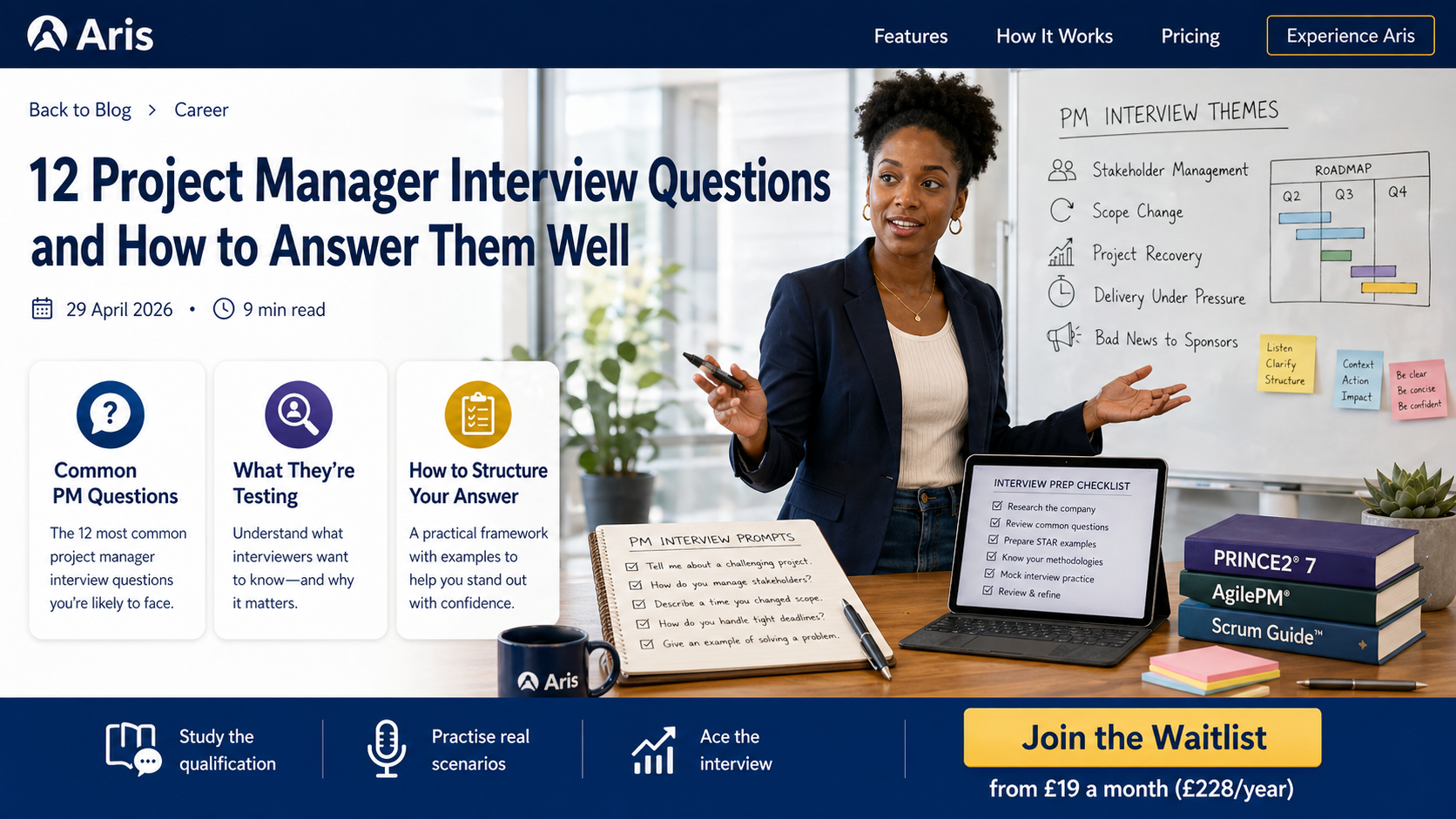
The thing nobody tells you about PM interviews
You can pass PRINCE2. You can hold AgilePM and PSM I and a stack of certs longer than your CV. The PM interview is a different test. Hiring managers aren't really asking whether you know the methodology. They're trying to work out whether you'd be the calm, judgement-led adult they want sitting in next month's steering committee.
That's actually a relief, once you see it. You don't have to recall the seven principles of PRINCE2 in order. You have to sound like someone who has been in the room when a project goes sideways and didn't make it worse.
STAR is fine. It's also not enough.
Most interview-prep guides hand you the STAR framework. Situation, Task, Action, Result. It's not bad. For a behavioural question like "tell me about a time you delivered a project under pressure", STAR gives you a tidy spine. The trouble is half the questions in a real PM interview aren't behavioural. They're situational. "Walk me through how you'd run a kickoff" doesn't have a Situation from your past to draw on. It's a thinking-aloud test.
So use STAR when the question starts with "tell me about a time". When the question starts with "how would you" or "walk me through", switch modes: structure your thinking out loud, name the trade-off, pick a path, justify it. That's the move that signals you've actually run projects rather than just memorised an exam. If you're a career changer with no PM history to draw on yet, we've gone deeper on how to answer "tell me about a time" questions when you don't yet have the experience.
UK PM interviewers are quietly grading three things behind every question. Can you explain a complex situation simply. Do you take responsibility when something goes wrong. Would you be a calm presence in the room when the project's on fire. The questions are the surface. Those three traits are the whole interview.
The 12 questions, what they're really testing, and how to answer
1. "Tell me about a project you're proud of." The warm-up, and underrated. Most candidates bury their best example here trying to sound humble. Pick a real project, name the outcome in one sentence, and get quickly to the bit that was hard. If you open by listing scope and stakeholders, you've already lost the room. Lead with what made the project genuinely yours.
2. "Walk me through a project that didn't go well." The killer. The candidate who claims none of their projects went badly is the candidate who hasn't run anything serious. Pick a real one. Be specific about what went wrong. Take responsibility for your part of it. End with what you actually changed in the next project as a result. The point of this question isn't the failure. It's to see whether you can tell the truth about your own work without flinching.
3. "How do you handle a stakeholder who keeps changing scope?" What they're testing: can you manage upwards without becoming the obstacle? Don't say "I refer them to the change control process". That's the cert answer. The real answer sounds more like: I keep a running impact log, I make every change visible to the sponsor at the next steer, and I let the people paying for the project see what their changes are costing them. Most senior stakeholders quietly stop changing things when they see the maths.
4. "Tell me about a time you had to push back on a senior leader." Behavioural and political. They want to see whether you can disagree with someone more senior without sounding either cowardly or aggressive. Use STAR. Pick a real example, name the person's role rather than their name, describe the disagreement specifically, and crucially, end with what happened next. Did you change their mind. Did they overrule you and the project paid for it. Did you find a third option together. The richer the resolution, the better the answer.
5. "How would you run a kickoff for a new project tomorrow?" Situational. Think aloud. Walk them through your first 48 hours: get the sponsor and the key stakeholders in a room (or on a call), agree the goal in one sentence, agree the constraints (time, money, people), surface the unknowns nobody's said out loud yet, and leave the meeting with a clear next step and a date for the first proper plan. Resist the temptation to show off the framework. They want to see the instincts.
6. "What do you do when everything is priority one?" Trick question. The honest answer is that you go back to the sponsor and force a conversation about which thing matters most, because nothing being negotiable means everything's going to slip. Strong candidates name a tool (impact-effort matrix, MoSCoW, weighted scoring) and then immediately say it's secondary. The real skill is the conversation, not the matrix.
7. "Tell me about a time you had to deliver bad news to a sponsor." The mature-PM question. They want to see whether you'd hide the problem or surface it early. Use STAR. Lead with what you brought, when, and why early. End with how the sponsor reacted and what you'd do differently. Bonus points if the example includes a moment where you took responsibility for delaying the bad news the first time and learned to bring it sooner.
8. "How do you handle a team member who isn't pulling their weight?" People management. Don't say "I'd escalate to their line manager" as your first move. That makes you sound like the kind of PM nobody wants to work for. Real answer: have the direct conversation, in private, early, framed as understanding before judgement. Often there's something going on you don't know about. If the conversation doesn't land or the issue continues, then yes, line manager. Not as the opening play.
9. "Walk me through how you'd recover a project three weeks behind, with no budget to add resource." Situational. There are really three honest moves: re-scope (cut something the sponsor cares about least, with their permission), re-sequence (deliver the highest-value bit first and keep going), or extend (have the honest conversation about the new date). Strong candidates name all three, say which one they'd reach for first, and explain why. The wrong answer is "I'd ask for more resource", because you've just been told there isn't any.
10. "What's the difference between PRINCE2 and Agile, and when would you use each?" Methodology question. UK PM interviewers love this one because it filters out the candidates who've memorised one framework and don't really get what either is for. Honest answer: PRINCE2 is the governance layer, Agile is the delivery layer, and they're not actually competing. PRINCE2 tells you who decides and who's accountable. Agile tells you how the work gets built. In UK public sector and consulting, the two stacked together is the normal setup. AgilePM is the bridge if you want one cert that covers both worlds.
11. "How do you measure project success beyond on-time, on-budget?" The depth question. Most candidates blank here. What they're looking for: business outcome (did the thing actually move the metric?), stakeholder confidence (would the sponsor hire you again?), and team learning (did the team come out of this stronger or burnt out?). On-time-on-budget is a hygiene factor. It isn't success.
12. "Why this role, and why now?" The closer. Most candidates blow this by reciting the job description back at the interviewer. Strong answer: name two specific things about this role that aren't in the JD (you researched the company, you spoke to someone who works there, you know what their last project failure was), and one specific thing about your own trajectory that makes the timing right for both sides. Specificity wins. Generic "I'm passionate about delivery" loses every time.
The word that comes up in every PM interview
Somewhere in the conversation, the interviewer will ask you for "an example". They mean it. Offer a generic principle ("I think clear communication is important") and you've failed the test. Offer a specific story with a real outcome and you've passed it. The single biggest predictor of who gets a PM offer is the willingness to talk about specific projects, specific decisions, and specific consequences. Vagueness is the enemy.
Where Aris fits in
The honest version of preparing for a PM interview is fewer flashcards and more reps. You can read every list of questions on the internet and still freeze the first time someone asks you to walk through a project that went badly. The fix is having the conversation, out loud, more than once, before you walk into the room.
That's the gap we built Aris to close. As well as teaching the qualifications, Aris walks you through voice-based simulations of the situations PM interviews actually test you on. The senior leader you have to push back on. The sponsor you have to deliver bad news to. The team member who isn't pulling their weight. You practise the conversation, Aris scores you, then you do it again. The version of you who walks into the interview is the one who's already had the difficult conversation a few times. Hiring managers can hear the difference.
You can do the rehearsal somewhere else if you'd rather. Find a coach, a mentor, a friend who's hired PMs before. The rule isn't where the practice happens. The rule is that it happens before the interview, not in it.
If you do only one thing before the interview, pick three of the questions above, write down a specific example for each, and read your answer out loud to yourself. The difference between the version in your head and the version that actually comes out of your mouth is bigger than you think.
The honest takeaway
PM interviews are won on specificity, calm, and the willingness to talk about a project that went sideways without blaming anyone but yourself. STAR helps. Situational thinking helps more. Rehearsal helps most. The candidate who walks in having said the words out loud already, even just to themselves, will outperform the one who's only read about the framework. Almost every time.
The PM interview is its own test. Walk in already prepared for it.
Study, practise, and advance with Aris.
Join the waitlist