Professional Scrum Master (PSM I): Your 2026 Guide to Getting Certified
You're probably already doing Scrum
If you're anywhere near software delivery, product development, or IT project work, chances are you've been using Scrum without necessarily calling it that. The daily stand-ups, the two-week sprints, the retros where everyone says "that went well" and quietly moves on. It's the rhythm of most modern teams.
There's a meaningful difference between participating in Scrum ceremonies and actually understanding the framework well enough to lead it. A good Scrum Master isn't the person who books the meetings and chases the Jira updates. They're the person who helps a team do their best work by removing obstacles, facilitating honest conversations, and protecting the process when pressure mounts. That's a real skill, and right now around three-quarters of UK organisations say they can't find enough people who have it.
Demand for certified Scrum Masters is projected to grow around 24% through 2026. If you've been thinking about formalising your agile knowledge, PSM I is the certification that carries the most weight for the least cost.
PSM I or CSM? Let's settle this
This is always the first question, so let's address it directly. There are two main Scrum Master certifications and they both put "Certified Scrum Master" on your CV. But the routes are quite different.
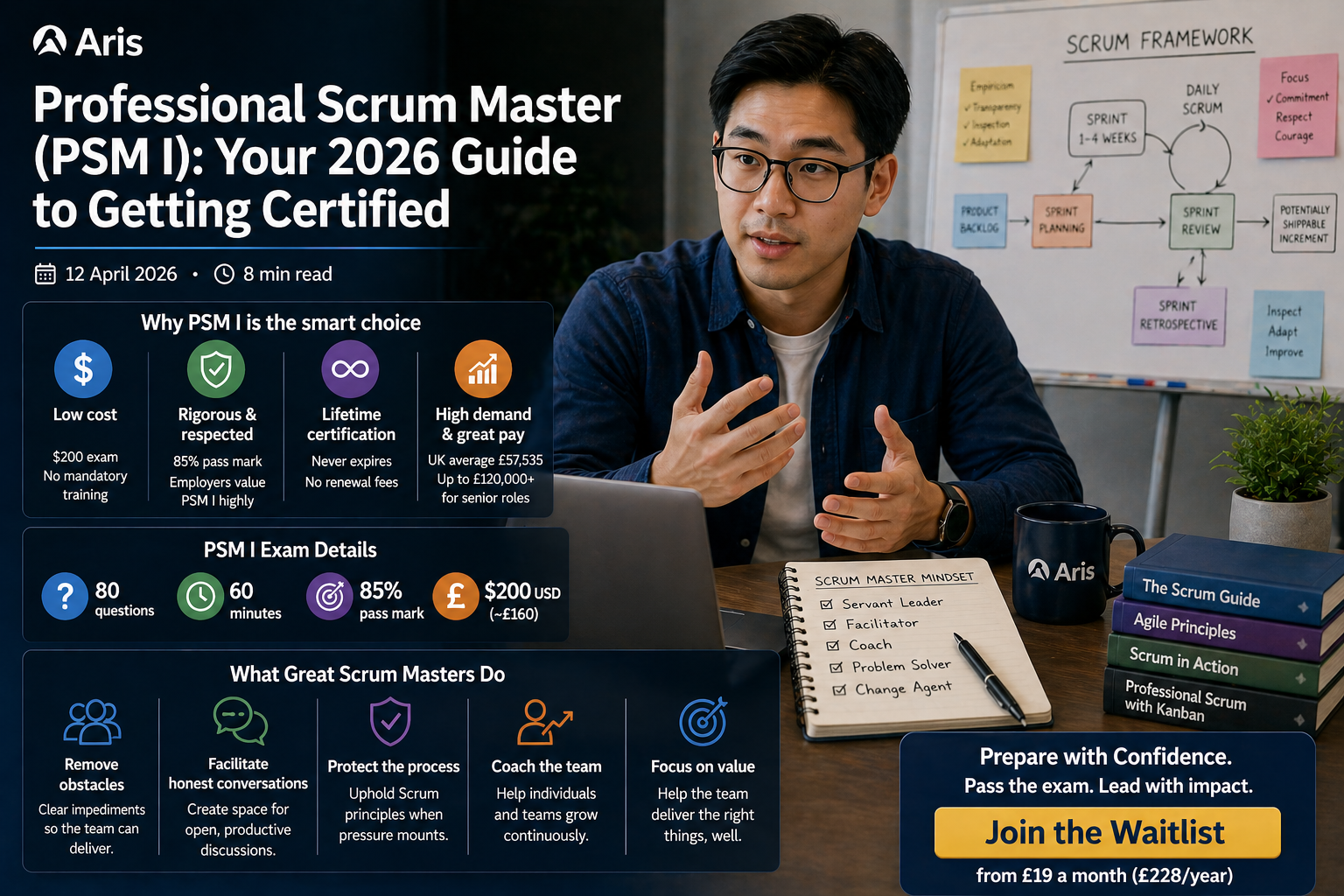
PSM I from Scrum.org costs $200 for the exam. There's no mandatory training course, so you study however works for you and sit the exam when you're ready. The pass mark is 85%, which is high. 80 questions in 60 minutes. It never expires and there are no renewal fees.
CSM from Scrum Alliance requires you to attend a 2-day course first, typically costing £800-£1,200. The exam afterwards is easier (50 questions, 74% pass mark) and the certification expires every 2 years with a renewal fee.
Honest take: PSM I is the stronger certification for most people. Cheaper overall, more rigorous, and the fact it doesn't expire means you're not paying for it indefinitely. Employers who understand the difference respect PSM I more. Those who don't will see "Scrum Master" on your CV either way and won't know the difference.
What the exam is actually testing
Here's what trips most people up: the Scrum Guide is only 13 pages long. That makes it feel easy. You can read the whole thing over lunch. The PSM I exam doesn't test whether you've read those 13 pages. It tests whether you've understood them deeply enough to apply them when the scenario doesn't have a straightforward answer.
The questions look like this: "A stakeholder asks the Development Team to add a high-priority feature mid-Sprint. What should the Scrum Master do?" You won't find that answer by searching the Scrum Guide for "mid-Sprint changes". You need to understand why Sprints are timeboxed, what the Scrum Master's accountability actually means, and how to protect the team's focus while still respecting the stakeholder's concern.
Across the 80 questions you'll be tested on Scrum theory and the empirical process, where the Scrum Master's accountability ends and the Product Owner's or Developers' begins, how to facilitate Sprint events well (and what to do when they go wrong), how the Product Backlog and Definition of Done work in practice, and how to coach teams through Scrum adoption when it's going sideways. The pattern is consistent: name the principle, recognise the situation, pick the right move.
Exam details: 80 questions in 60 minutes. 85% pass mark. $200 USD (around £160). Lifetime validity, no renewal fees.
That time pressure is real. Sixty minutes for 80 questions gives you roughly 45 seconds per question. The understanding has to be instinctive, not something you're reasoning through from first principles each time. That's what separates people who pass comfortably from people who run out of time.
What Scrum Masters actually earn in the UK
The salary picture reflects the talent shortage. When three-quarters of UK organisations say they can't find qualified Scrum Masters, the qualified ones have leverage. The numbers, roughly:
- UK average: £57,535
- London: £62,495
- Experienced (8+ years): £77,112
- Senior or lead roles: up to £120,000
Strong numbers, especially considering PSM I costs $200 and takes two to three weeks to prepare for. The ROI timeline is about as short as it gets in the certification world.
How to prepare properly
Start with the Scrum Guide. Not a summary. Not someone else's notes. The actual Scrum Guide from scrumguides.org. Read it carefully, not quickly. Most people skim it because it's short, assume they've understood it, and then discover during the exam that they hadn't.
After you've read it properly, use Scrum.org's free Open Assessments to test yourself. They're not identical to the real exam questions, but they mirror the format and difficulty level. If you're consistently hitting 100% on those, you're in good shape. Anything below 90% means there are gaps you haven't found yet.
The challenge with pure self-study is that you can read the same 13 pages ten times and still hold a subtle misunderstanding that costs you marks. When the pass mark is 85%, those subtleties matter. You need something that tests your understanding, not just your memory.
Aris prepares you for PSM I through real conversation rather than cramming. Aris presents scenarios and asks what you'd do. Your response shows whether you genuinely understand the principle or whether you've just memorised the wording. When there's a gap, Aris addresses it in the moment. That's the kind of depth the exam demands, and it's hard to develop alone from a 13-page document.
The exam is one test. The job is a different one.
Here's the thing about being a Scrum Master. The exam tests your knowledge of the framework. The job tests something completely different. It tests your ability to facilitate conversations, handle conflict, coach people through change, and stand your ground when a manager wants to skip the retrospective because "we're too busy". Those are people skills, and they're what separates a certified Scrum Master from a good one.
That's the second gap Aris closes. Voice-based simulations of the situations you'll actually face. A developer who's disengaged during planning. A stakeholder pressuring the team to add scope mid-Sprint. A Product Owner who can't prioritise. You practise the conversation, Aris scores you on how you handled it, then you do it again. That's how the facilitation instincts get built. No amount of reading substitutes for it.
References
- Scrum.org PSM I certification: scrum.org
- UK Scrum Master salary data: glassdoor.co.uk
- Scrum adoption data: Scrum Alliance State of Scrum Report