Why Passing the Exam Is Only Half the Battle
You passed. Now what?
You've spent weeks studying. You passed the exam. You updated your LinkedIn with the shiny new credential. You're feeling good about it.
Then you start applying for roles. And something doesn't add up.
The entry-level positions want "2-3 years experience." The interview questions ask about situations you've never been in. The hiring manager seems more interested in how you'd handle a difficult stakeholder than whether you can recite the seven PRINCE2 themes.
Your certification got you through the door. But the interview is testing everything the exam didn't.
The gap nobody talks about
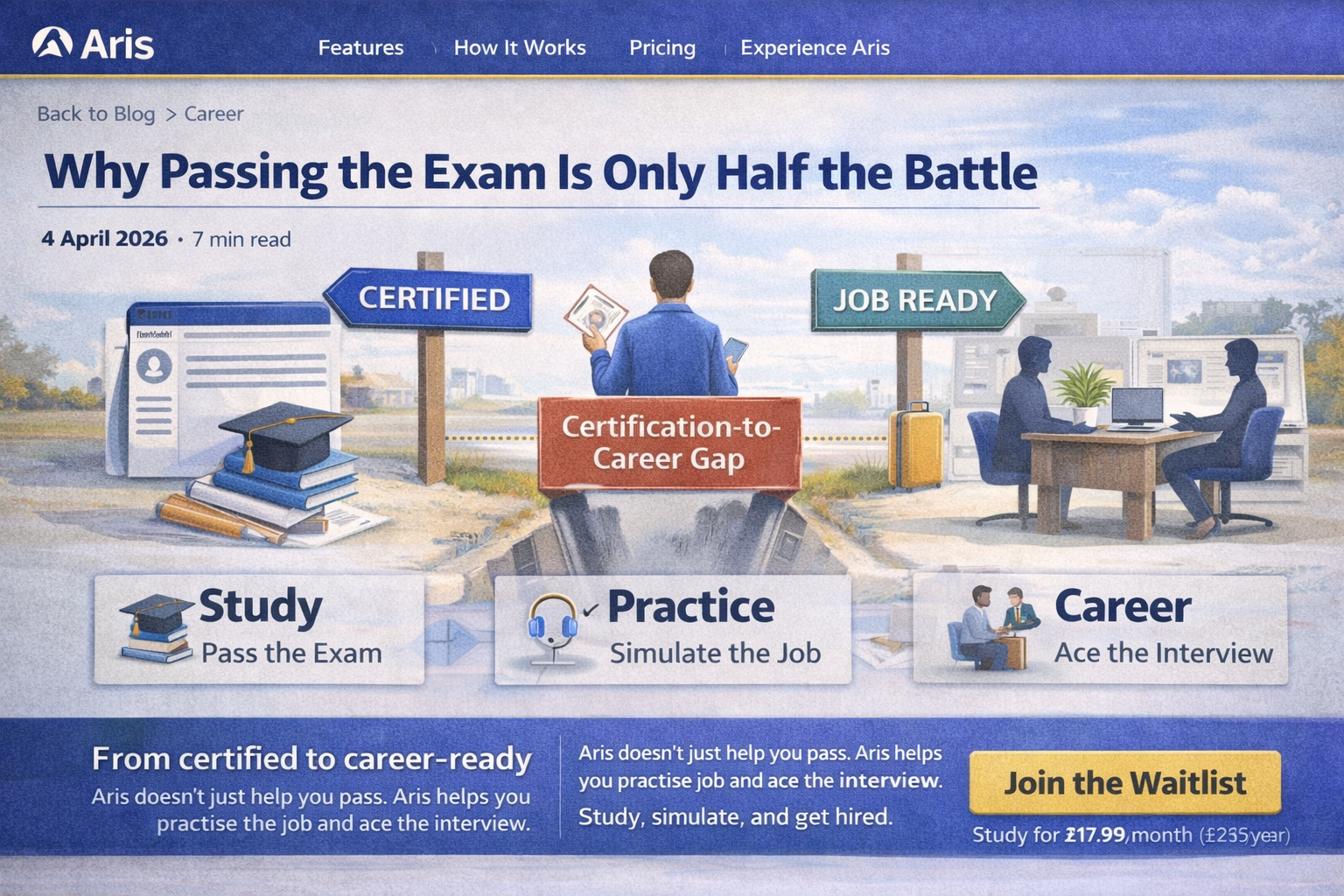
We call this the certification-to-career gap. It's the distance between knowing what PRINCE2's seven themes are and managing a real stakeholder who's pushing back on your timeline. Between understanding AWS VPC architecture on paper and designing one when the deadline is tomorrow. Between memorising security frameworks and keeping your composure when someone asks you to walk them through an incident response.
This gap exists because certification exams test knowledge. Jobs require application. And almost nothing in the traditional certification process prepares you for that transition.
What hiring managers are actually looking for
Here's what they won't tell you in the job description: the certificate gets your CV past the automated filter. After that, it's almost irrelevant. What matters in the interview is whether you can demonstrate that you've done the work, not just studied it.
The APM Salary and Market Trends Survey 2025 found that 82% of project professionals cite salary as their top priority when job hunting. But employers consistently rank communication, leadership, and problem-solving above certification when evaluating candidates.
Think about the questions you'll face:
- "Tell me about a time you managed a difficult stakeholder."
- "How would you handle a project that's falling behind schedule?"
- "Describe a situation where you had to make a decision with incomplete information."
These aren't knowledge questions. They're experience questions. And if all you've done is study, your answers sound like textbook responses. "I would follow the PRINCE2 escalation process" is technically correct. It also tells the interviewer you've never actually had to escalate anything. There's a deeper read on how to answer these honestly when you don't yet have the experience, if that's where you're stuck.
The interview is a performance, and you haven't rehearsed
Here's what most people don't realise until they're sitting across from the interviewer: an interview is a live performance. You're thinking on your feet, reading the room, structuring answers in real time, and trying to sound confident while your heart is racing.
Nobody performs well the first time they do something under pressure. Actors rehearse. Musicians practise. Athletes train. But somehow, candidates are expected to walk into high-stakes interviews and deliver polished, experience-rich answers with zero preparation beyond reading their own CV in the car park.
That's the gap. Not knowledge. Preparation.
What if you could practise before it mattered?
Imagine you're on a call with an operations manager named Mark. He's sceptical about the new framework your project is rolling out. He says: "I've seen these changes before and they usually just slow my team down. What makes this different?"
What do you say? Do you defend the framework? Do you ask what went wrong last time? Do you acknowledge his concerns first?
That's what simulation practice feels like. You're in the scenario. You have to respond in real time. The AI persona reacts differently depending on what you say. After the conversation, you get scored across communication, decision-making, knowledge, and professionalism. You see exactly where you were strong and where you fell short.
Do that three or four times, and when the real interview comes around, you've already handled these situations. The nerves are still there, but the unfamiliarity isn't.
Interview prep is the step everyone skips
Most certification courses end at the exam. You pass, you celebrate, you move on. But the actual goal was never to pass. It was to get hired, get promoted, or change careers. The interview is the bridge between the certificate and that outcome. And almost nobody builds that bridge.
Effective interview preparation means practising competency answers with realistic scenarios. Running through questions tailored to the specific job description you're applying for. Getting feedback not just on whether your answer was correct, but on how you communicated it, how you structured your thinking, and how you came across.
You wouldn't sit an exam without doing practice questions first. So why would you walk into an interview without practising the interview?
Putting it all together
The professionals who advance fastest combine three things:
- Study: Learn the material through something that adapts to how you think, not a pre-recorded video that plays at the same speed regardless.
- Practice: Build practical skills through scenarios that feel real. Get scored feedback so you know what to improve.
- Career prep: Prepare for interviews with simulations based on actual job descriptions. Walk in with stories to tell, not just theory to recite.
This is exactly the gap we built Aris to close. You start by learning through real conversation, with Aris adapting to how you think. Once you're confident in the material, you step into workplace scenarios and practise the professional situations the job actually involves: the difficult stakeholder, the tough negotiation, the moment when you have to think on your feet. Then when you're applying for roles, Aris rehearses you through interviews tuned to the actual job description. The exam is step one. Aris walks you through steps two and three.
Want to see what that feels like? Try the interactive demo on our homepage. Walk through a real lesson, take a quiz, and step into a stakeholder simulation first-hand.
The bottom line
Passing the exam is a milestone. It's not a finish line. In a market where certified project professionals earn £52,500 and AWS-certified professionals earn up to £68,500, the salary premium is real. But it goes to the candidates who can demonstrate they're ready for the role, not just certified for it.
Don't stop at the certificate. Keep going until you're genuinely ready for the job.
References
- APM Salary and Market Trends Survey 2025: apm.org.uk
- UK Government TechFirst programme: gov.uk
- AWS certified salary data UK: itjobswatch.co.uk