AWS Certifications in 2026: Which One Should You Start With?
There are too many AWS certifications. Let's simplify it.
AWS now has more than a dozen certifications across four levels. If you're new to this, that's overwhelming. You've probably spent an hour on AWS's own certification page and come away more confused than when you started.
So let's cut through it. Which one should you actually get first? How long will it take? And is it worth the time if you're working full-time alongside?
If you're brand new: start with Cloud Practitioner
The AWS Certified Cloud Practitioner is the entry point. It's designed for people with little to no AWS experience. The exam covers cloud concepts, core AWS services, security basics, and billing. It's not deeply technical and you don't need hands-on experience to pass.
It costs $100 USD (roughly £80) and most people study for 2-4 weeks at a comfortable pace. That's a low-risk way to validate that cloud is the direction you want to go before committing months to a harder certification.
If you have IT experience: go straight to Solutions Architect
Here's something people waste time on: doing Cloud Practitioner when they don't need to. There's no prerequisite chain. AWS doesn't make you pass Foundation before attempting Associate. If you've got a year or more of IT experience and you're comfortable with basic networking and system concepts, skip Cloud Practitioner and go straight to Solutions Architect Associate.
This is the certification UK employers want most. It tests your ability to design real distributed systems on AWS: picking the right services, making them secure, keeping costs reasonable, and building architectures that don't fall over at scale.
The exam costs $150 USD (roughly £120). Most people prepare over 2-3 months, studying 10-15 hours per week. To put that in real terms: that's every evening after work for about three months. It's a serious commitment, and you genuinely need hands-on practice, not just video watching.
The wider AWS map, briefly
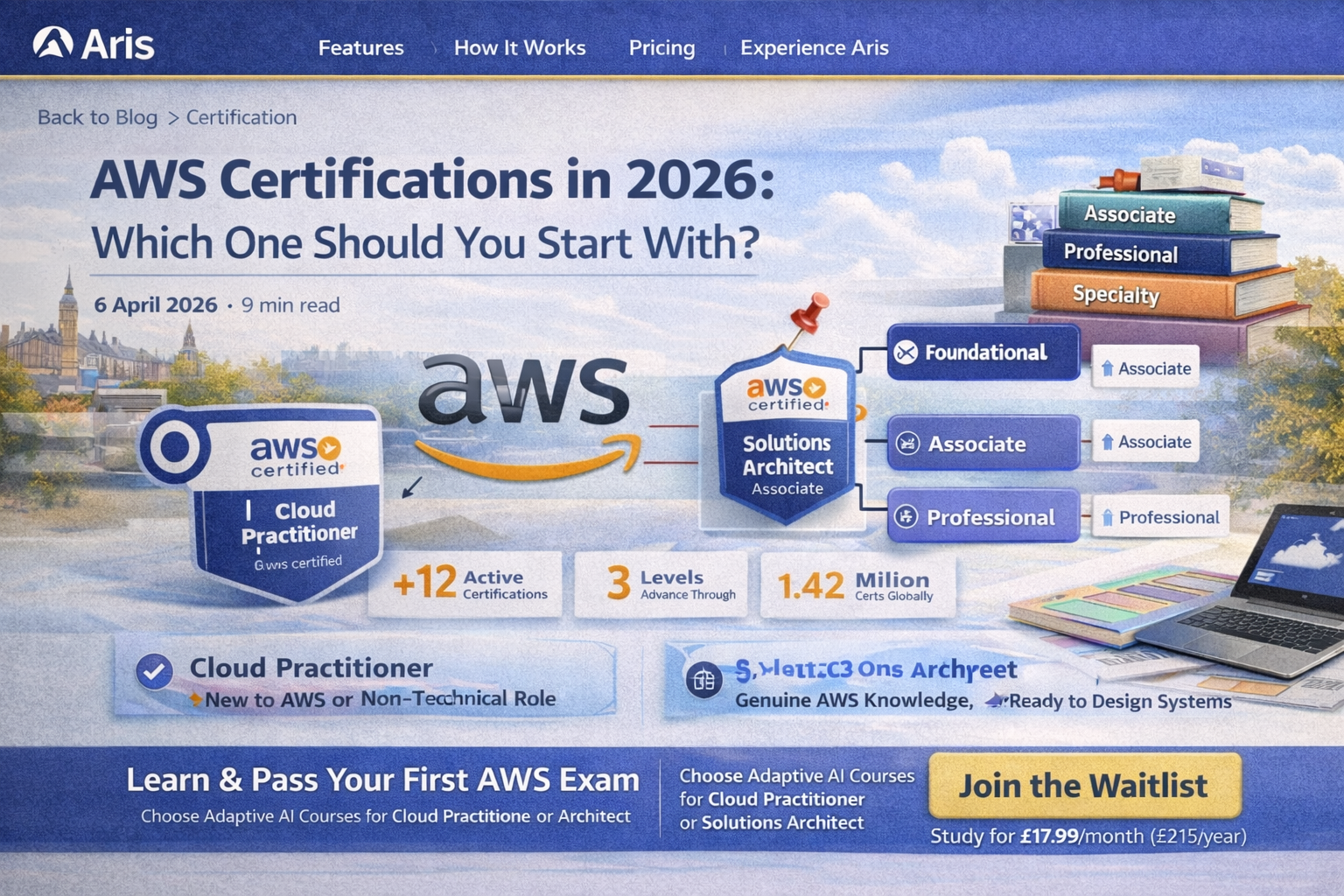
If you're going to keep going past your first cert, this is the rough shape of what's available. Foundational level is Cloud Practitioner and AI Practitioner. Associate level is Solutions Architect, Developer, and CloudOps Engineer (the rebranded SysOps role). Professional level adds Solutions Architect Professional, DevOps Engineer Professional, and the newer Generative AI Developer Professional. Specialty certs (Security, Database, Machine Learning, Data Analytics) are for people going deep into a specific area.
All AWS certifications are valid for three years. After that you get 180 days to recertify at a reduced $75 fee, or you can recertify for free by passing a higher-level exam. Most people don't need to plan that far ahead. Earn the first one, see how the role goes, then decide.
How long each one actually takes
These are realistic timelines for someone studying alongside a full-time job:
- Cloud Practitioner: 2-4 weeks. A few hours most evenings. Very manageable.
- Solutions Architect Associate: 2-3 months. This is the one that requires real discipline. You'll have weeks where you question whether it's worth it. It is.
- Developer Associate: 2-3 months, but you need coding experience going in.
- Professional level: 3-6 months. These assume you already have Associate-level knowledge and real AWS experience.
Bootcamps promise to compress these timelines to 1-2 weeks. That works for passing the exam. It doesn't work for actually understanding the material well enough to perform in a job.
What it'll cost you
Foundational exams: $100 USD (~£80)
Associate exams: $150 USD (~£120)
Professional/Specialty: $300 USD (~£240)
After passing any AWS exam, you get a 50% discount on your next one.
The exam is the cheap part. Training is where costs balloon. Official AWS classroom courses run $600-$2,000+. UK bootcamps charge £500-£1,500. Cheap online video courses go for £10-50 on sale, but there's a big gap between watching 40 hours of recordings and actually being able to design cloud architecture when someone asks you in a meeting.
The most cost-effective approach is combining AWS's own free digital training (Skill Builder) with a low-cost online course and the AWS Free Tier for hands-on practice. That gets you to exam-ready for under £200. The question is whether you can stay structured and motivated without a teacher.
That's what it costs. Here's what it earns you.
What UK employers are paying
Cloud is the most in-demand IT skill in UK job postings in 2026. AWS and Azure are the two certifications employers ask for most, and there aren't enough qualified people to fill the roles.
UK salary ranges for AWS-certified professionals:
Early career (1-4 years): £51,831
Mid-career (5-9 years): £60,505
Late career (10-19 years): £68,505
The strongest demand is in London, the South East, Manchester, and Edinburgh. Financial services, government, healthcare, and media are the sectors hiring hardest.
How to actually pass
Three things matter more than anything else:
Build things. The exam is scenario-based. It describes a situation and asks you to choose the best solution. You can't reason through these without having actually used the services. Even simple projects (hosting a static site on S3, setting up a VPC, deploying a Lambda function) give you the context you need.
Take practice exams seriously. At least two full practice exams under timed conditions before the real thing. If you're consistently scoring above 80%, you're ready. If not, you know exactly where to focus.
Don't just memorise services. Understanding why one approach is better than another is what separates people who pass from people who don't. The exam doesn't ask "what does S3 do?" It asks "given these requirements, which storage solution would you choose and why?"
If you want structured guidance through the foundational AWS certs, Aris teaches AWS AI Cloud Practitioner through real conversation rather than hours of video, with concepts checked before you move on. Hands-on labs for the deeper Associate-level certs sit outside Aris's lane (you'll want the AWS Free Tier and Skill Builder for that). Where Aris does meaningfully close the gap is the bit between passing and getting hired: practising how to talk through your AWS knowledge in an interview, the kind of conversation that's often the difference between getting the role and losing it to someone who presents better.
Start your AWS certification journey with Aris.
Study, practise, and advance with Aris.
Join the waitlistReferences
- AWS Certification exam pricing: aws.amazon.com/certification/faqs
- AWS recertification policy: aws.amazon.com/certification/recertification
- AWS certification list: aws.amazon.com/certification
- AWS salary data UK: itjobswatch.co.uk
- UK IT certification demand 2026: itjobboard.co.uk