What a Cybersecurity Analyst Actually Earns in the UK
The number you actually came here for
The honest answer to "what does a cyber security analyst earn in the UK" is more interesting than the headline figure Google hands back. It also depends more on what kind of cyber analyst, where in the country, and for whom, than most salary articles let on. Most quote you a median, shrug, and move on. So let's actually do the work.
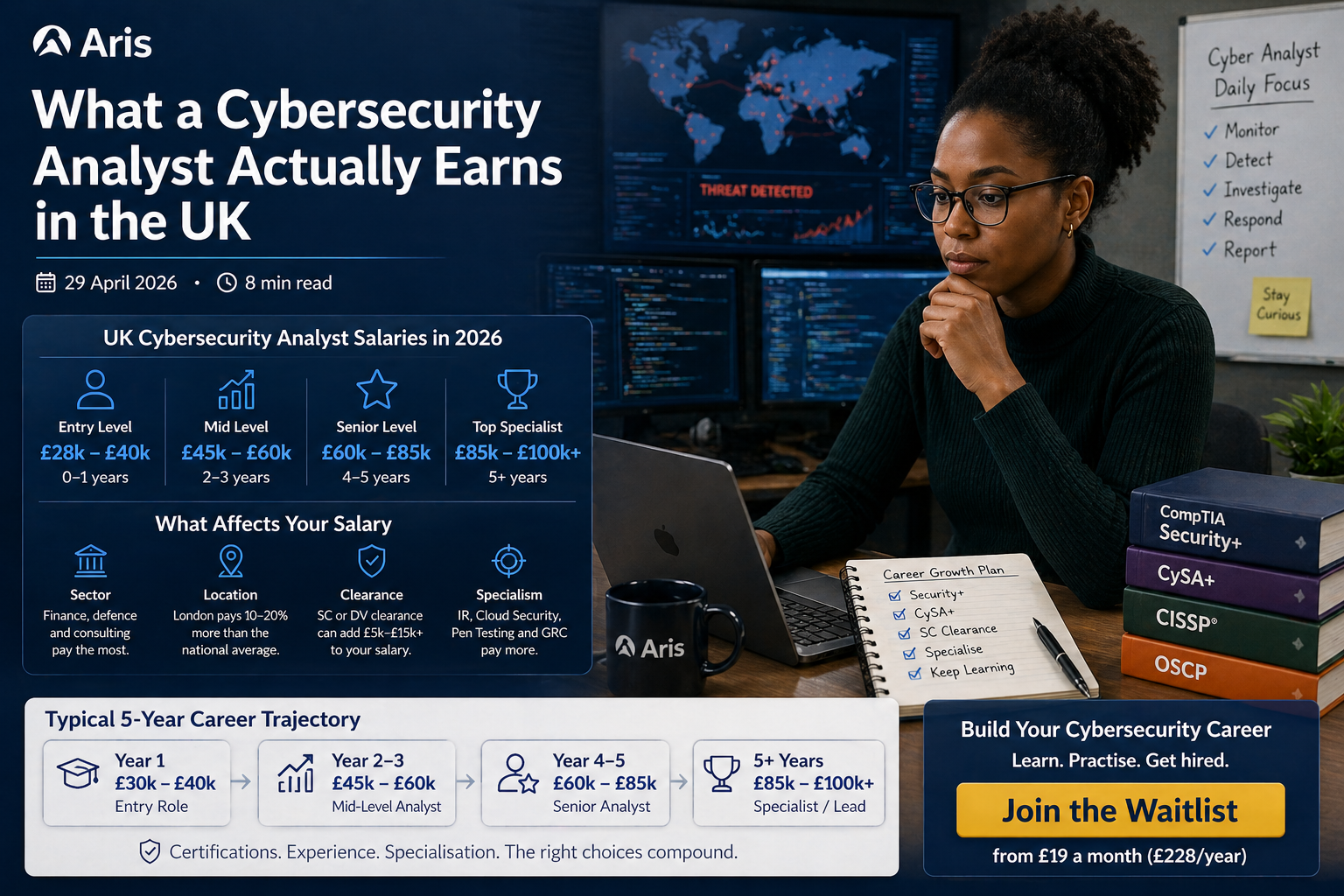
Median UK salary for a cyber security analyst in 2026 sits in the £50,000 to £55,000 region. Entry roles start around £30,000 to £40,000. Senior and specialist analysts earn £65,000 to £85,000. The good ones in the right specialism in the right city clear £100,000 without too much drama. That's the spread.
Now the bits nobody quotes properly.
The salary you'll actually be offered has very little to do with the headline number. It has a lot to do with whether you're in London, what sector you're in, whether you hold security clearance, and whether you've specialised. The headline number is a midpoint between very different worlds.
Entry level, with the bit recruiters don't mention
If you're moving into cyber from another career, your first role is rarely going to be the one with the salary you imagined. Most career changers land in one of three places: a SOC analyst seat (often shift-based), a junior analyst role inside a larger security team, or a graduate-style scheme inside consulting or defence. Pay at this stage is typically £28,000 to £40,000 depending on which of those three you walked into.
SOC roles tend to start at the lower end of that range, partly because they're shift-based and partly because demand for entry roles is high. The trade-off is that progression is fast. People who are good in a SOC for 18 months are routinely promoted into mid-level analyst roles paying significantly more, or move out into incident response or threat intelligence specialisms where the numbers jump.
Public sector entry roles (NCSC, MoD-adjacent contractors, NHS Digital, large local authorities) usually start in the £30,000 to £40,000 range. The numbers look modest until you factor in the pension, holiday, and the genuinely valuable career step that having "I worked on government cyber" on your CV gives you for the rest of your career.
What actually moves the number
Four things do most of the work. Most salary articles miss at least two of them.
Sector. Finance, defence, and the larger consultancies pay the most. Public sector and charity pay the least, but they often offer a faster route in for career changers and tend to value certifications like Security+ heavily. Healthcare and education sit in the middle. Private sector tech and SaaS companies hire well-paid in-house security teams but are pickier about prior experience.
Region. London adds about 10 to 20 percent to the headline. Bristol, Manchester, Edinburgh, Reading, and Cambridge cluster behind London because of the consultancies and the defence contractors based there. Regional roles outside those hubs are typically 10 to 15 percent below the median. Remote roles tend to pay closer to regional than London, which is the bit nobody tells you when they sell you the remote dream.
Clearance. If you can hold UK security clearance (SC or DV), you have access to a different pay band entirely. SC clearance is genuinely worth £5,000 to £10,000 on top of an equivalent uncleared role. DV is often worth £10,000 to £15,000 plus, and there are plenty of roles that simply won't see your CV without it. Most career changers don't think about this until they're already in. Worth thinking about earlier.
Specialism. Generalist SOC analyst pays one number. Incident response, threat intelligence, cloud security, penetration testing, governance/risk/compliance (GRC) and application security all pay more, often a lot more. The further you go into a specialism, the higher the floor. Penetration testing in particular has a strong contract market in the UK with day rates that look very different to perm salaries.
The trajectory: what you can actually earn over five years
The single most useful frame for a cyber salary question is the trajectory, not the starting point. Career changers obsess about the entry-level number and underestimate the slope. The slope is what matters.
A typical UK trajectory for a focused cyber analyst, starting from a non-cyber background:
- Year 1. Entry role, £30,000 to £40,000. Security+ in your back pocket. Learning the operational side, getting into the rhythm of a SOC or junior team.
- Year 2 to 3. Mid-level analyst, £45,000 to £60,000. CySA+ or vendor-specific certs added. Maybe SC clearance by now if you took the right route. Specialising into incident response, cloud security, or threat intel.
- Year 4 to 5. Senior analyst or specialist, £60,000 to £80,000. CISSP if you're heading senior, OSCP if you're going pen-test, CISM if you're heading management. London or specialist roles can be £85,000 to £100,000.
- Year 5 plus. Specialist contract market, security architect, security manager, or senior consultant. £80,000 to £120,000+ for permanent roles, day rates of £600 to £1,000+ for contractors with the right credentials.
That's not the fast track. That's a normal, steady, "I keep showing up and getting the next cert" path. The fast track exists too, but it tends to involve a strong specialism, an early move to consulting, or landing a role in a hot vertical (cloud security, AI security, financial services).
Contract day rates, briefly
Once you have three to five years in cyber, the contract market becomes a real option. UK day rates for cyber analysts in 2026 sit roughly in this range: junior contractors £350 to £450 a day, mid-level £450 to £650, senior and specialist £650 to £900, top-end pen testers and architects £900 to £1,300+. Inside IR35 versus outside changes the take-home meaningfully and is its own discussion. The honest version is that perm is usually better when you're early. Contract pays off once you're senior, specialised, and willing to do the legwork to keep finding the next role.
The certs and clearances that bump the number
The cyber world is more cert-driven than most career fields, and the bumps are real. The honest hierarchy:
- CompTIA Security+. The doorway. Recognised by the UK Ministry of Defence and consistently appears in UK employer hiring lists. Almost every entry-level cyber role mentions Security+, either explicitly or by implication.
- CySA+ or vendor specifics (Microsoft SC-200, AWS Security Specialty). The mid-level credential that signals you're past the basics.
- CISSP. The single biggest single bump in cyber salaries. Senior-level. Five years experience minimum. Often unlocks a £10,000+ jump.
- CISM. If you're heading toward security management or GRC leadership. Pairs naturally with CISSP later in your career.
- OSCP. The cert that gets pen testers taken seriously. Hands-on, expensive, hard. Worth it if pen-testing is the path.
- SC or DV clearance. Not technically a certification but functions like one in the UK market. Worth real money. If you're considering a defence-adjacent route, it's worth taking the role that gets you cleared early, even if it pays slightly less for the first year.
Where Aris fits in
The cert is the starting line, not the finish. The career changers who actually break into UK cyber pay the highest are usually the ones who didn't just memorise Security+ for the exam. They learned to talk about the framework, walked through real incident scenarios, and rehearsed the kinds of conversations a hiring manager wants to hear in an interview.
That's the gap we built Aris to close. Aris teaches you Security+ through real conversation, then walks you through voice-based simulations of the situations cyber roles actually involve. The phishing alert that turns out to be a real incident. The risk conversation with a senior leader who doesn't want to hear it. The SOC handover where the previous shift left you a half-finished investigation. By the time you walk into the interview, you don't have to pretend you've handled this stuff. In a meaningful way, you have.
You don't strictly need Aris to do this. You do need somewhere to bridge the gap between "I have the certificate" and "I can talk credibly about a security incident". Wherever that practice happens, just make sure it happens before the first interview, not in it.
The candidate who walks into a cyber interview having actually rehearsed a security conversation will outperform the candidate who's only revised the framework. The salary at the end of that interview tends to reflect the difference.
The honest takeaway
The headline UK cyber security analyst salary is fine. The real money sits in the trajectory and in the choices you make about specialism, sector, region, and clearance. The career changers who do best aren't necessarily the ones with the most certs. They're the ones who picked a specialism early, got into a real team, kept stacking the right credentials, and learned to talk about cyber the way a hiring manager wants to hear it talked about.
Pick a path. Earn the doorway cert. Get into a real team. The rest, if you keep showing up, follows.
The cert opens the door. The role-readiness gets you paid for the work.
Study, practise, and advance with Aris.
Join the waitlist