How AI Is Changing Certification Prep in 2026
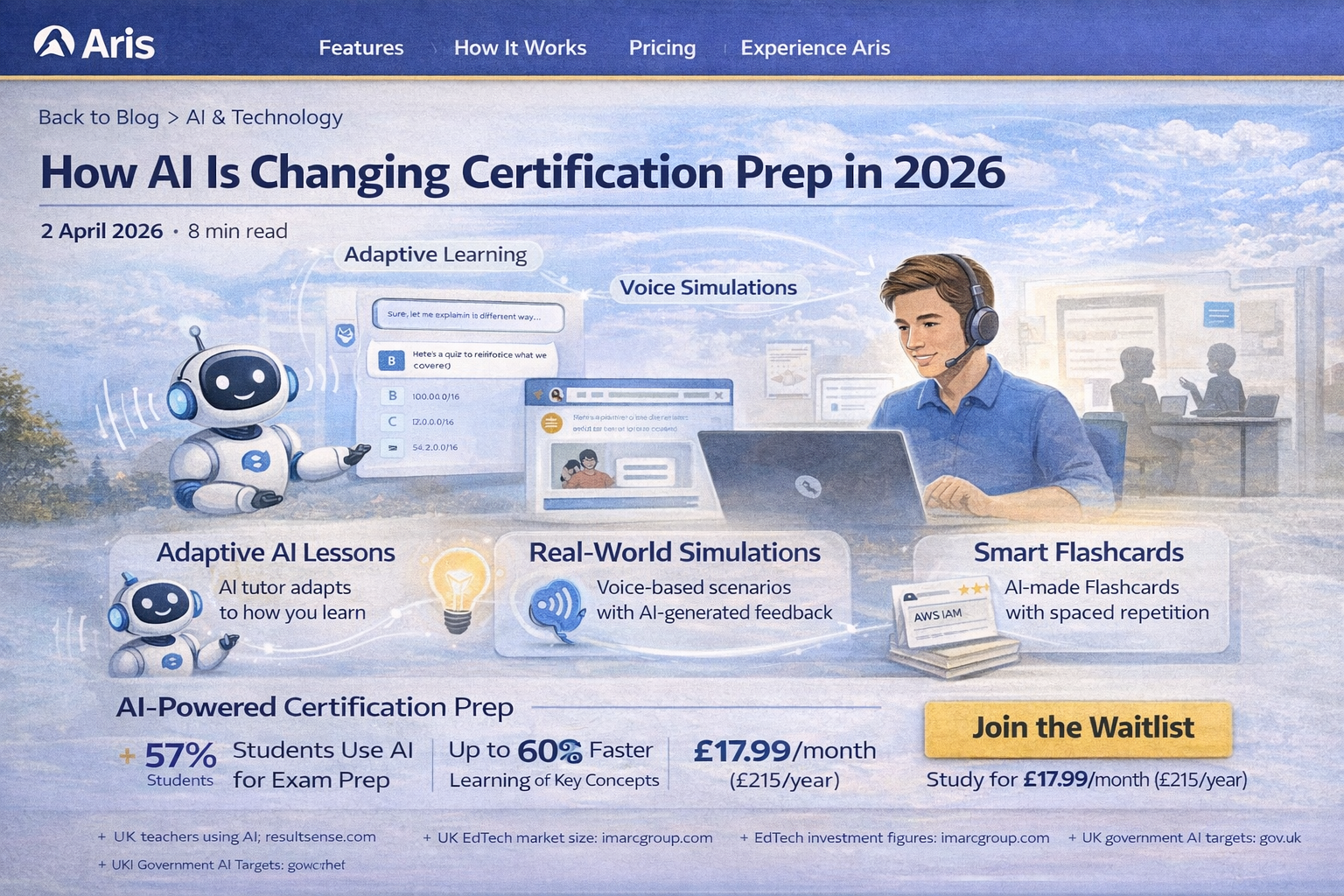
Something has shifted
If you studied for a certification five years ago, the options were straightforward: pay for a classroom course or teach yourself from videos and textbooks. Both had obvious problems. Classroom courses cost a fortune and moved at someone else's pace. Self-study was cheap but lonely, unstructured, and easy to abandon.
In 2026, there's a third option. And it's changing how people prepare for professional certifications in ways that are hard to ignore.
According to ResultSense, 76% of UK teachers now use AI tools for day-to-day work, up from 53% a year ago. Among students aged 13-18, 77% have used generative AI. The UK government has invested £187 million in its TechFirst skills programme and is targeting 10 million workers with AI skills by 2030.
AI isn't coming to education. It's already here. And for working professionals trying to get certified alongside a full-time job, the shift couldn't come sooner.
Why video courses stopped working
Be honest with yourself for a moment. How many online courses have you started and never finished?
Traditional certification prep goes like this: you sign up for a video course, watch the first few modules with genuine enthusiasm, start skipping ahead because the pace is too slow (or too fast), fall behind, feel guilty, and eventually stop logging in. The course sits in your account history, 34% complete, forever.
The problem isn't motivation. The problem is that pre-recorded content can't adapt. It doesn't know what you already understand. It can't tell when you're confused. It keeps going whether you're following or not. You're expected to fit the course instead of the course fitting you.
What learning through conversation actually feels like
AI-powered tutoring flips this. Instead of watching someone talk at you, you have a conversation. The AI teaches you a concept, then checks: "Does that make sense? Can you explain it back to me?" If you get it, you move on. If you're stuck, it tries a different approach. Maybe an analogy. Maybe a simpler breakdown. Maybe a question that helps you figure it out yourself.
Research on AI tutoring has shown improvement rates of up to 60% in test scores compared to traditional self-study. The personalisation is the key. When teaching adapts to the learner rather than the other way around, things stick.
Think about the best teacher you ever had. They probably didn't just lecture. They asked questions, adjusted their explanations based on your responses, and made you feel like they were teaching you specifically, not a room full of people. That's what good AI tutoring does, except it's available at 11pm on a Tuesday when your kids are finally asleep and you have 45 minutes to study.
That conversational approach is part of something broader that the industry calls "adaptive learning." But the term gets thrown around loosely, so it's worth understanding what it actually means.
Adaptive learning vs marketing buzzwords
"Adaptive learning" is a term every EdTech company throws around. Most don't actually deliver it. In practice, genuine adaptive learning means the system adjusts three things based on how you're doing:
- What you're taught: It identifies gaps and focuses there instead of repeating what you already know.
- The order you learn: It restructures the material based on your weaknesses, not a fixed syllabus.
- How fast you go: It speeds up when you're cruising and slows down when you need more time.
If a platform just serves you the next video in a playlist regardless of how you performed on the last quiz, that's not adaptive. That's a playlist.
For certification study, real adaptation means the system knows which exam domains you're weakest in and spends more time there. If you're scoring 90% on networking but 55% on security, a genuinely adaptive tutor shifts focus to security. A video course makes you sit through both equally.
Adaptive study helps you learn the material. But there's another side to the AI shift that goes beyond passing the exam.
Practising the job before you get it
Here's where things get interesting. The best AI learning tools don't stop at helping you pass the exam. They help you prepare for what comes after.
Voice-based simulations put you in realistic workplace scenarios. Instead of reading about how to handle a resistant stakeholder, you're on a call with one. An AI persona presents you with a challenge and you have to respond, in real time, with your actual voice. The conversation goes differently depending on what you say.
Afterwards, you get scored across communication, decision-making, knowledge application, and professionalism. You see exactly where you were strong and where you stumbled. Do it a few times and you start building the kind of practical confidence that no textbook can give you.
This matters because passing the exam is only half the battle. Employers want people who can do the job, not just pass a test about it. Simulation practice bridges that gap.
Not all AI tools are the same
The market is flooded with products that call themselves "AI-powered" because they have a chatbot. A chatbot that answers questions is useful, but it's not a tutor. It's a search engine with a friendlier interface.
If you're evaluating AI learning tools for certification prep, here's what actually matters:
- Does it teach, or just answer? A tutor takes you through material, checks understanding, and adjusts. A chatbot waits for you to ask something.
- Is the curriculum structured? It should follow official exam objectives, not random topics.
- Do assessments feed back into learning? If you fail a quiz, does the system re-teach what you got wrong, or just show you the correct answer?
- Is there practice beyond multiple choice? Simulations, scenarios, and interview prep test application. Multiple choice tests recall.
- Does it use spaced repetition? AI-generated flashcards that resurface at optimal intervals are how you retain information long-term, not just until exam day.
- Is the platform transparent about its AI? You should know which models power it and what limitations exist. If they won't tell you, that's a red flag.
The shift is already here
AI isn't replacing professional certification. PeopleCert, AWS, and CompTIA still set the standards and run the exams. What's changing is the path from "I want to get certified" to "I passed and I'm ready for the job."
That path used to require either £1,500+ for a classroom course or months of unstructured self-study with no feedback and no accountability. We built Aris to be the third option. Aris ticks every box on the checklist above: conversational teaching that adapts in real time, structured courses aligned with official exam objectives, quizzes that feed back into your learning path, voice-based simulations for real-world practice, spaced repetition flashcards, and a public AI transparency page explaining exactly how AI is used.
For working professionals studying around a full-time job, that combination of structure, adaptation, and practice across unlimited certifications can make the difference between finishing and giving up.
The version of certification prep we wished existed when we were the ones doing it.
Study, practise, and advance with Aris.
Join the waitlistReferences
- UK teacher AI adoption: resultsense.com
- NEU State of Education AI Report 2026: neu.org.uk
- UK EdTech market size: imarcgroup.com
- UK Government AI Action Plan: gov.uk
- UKRI AI Strategy: ukri.org