From AWS Cloud Practitioner to Your First Cloud Interview
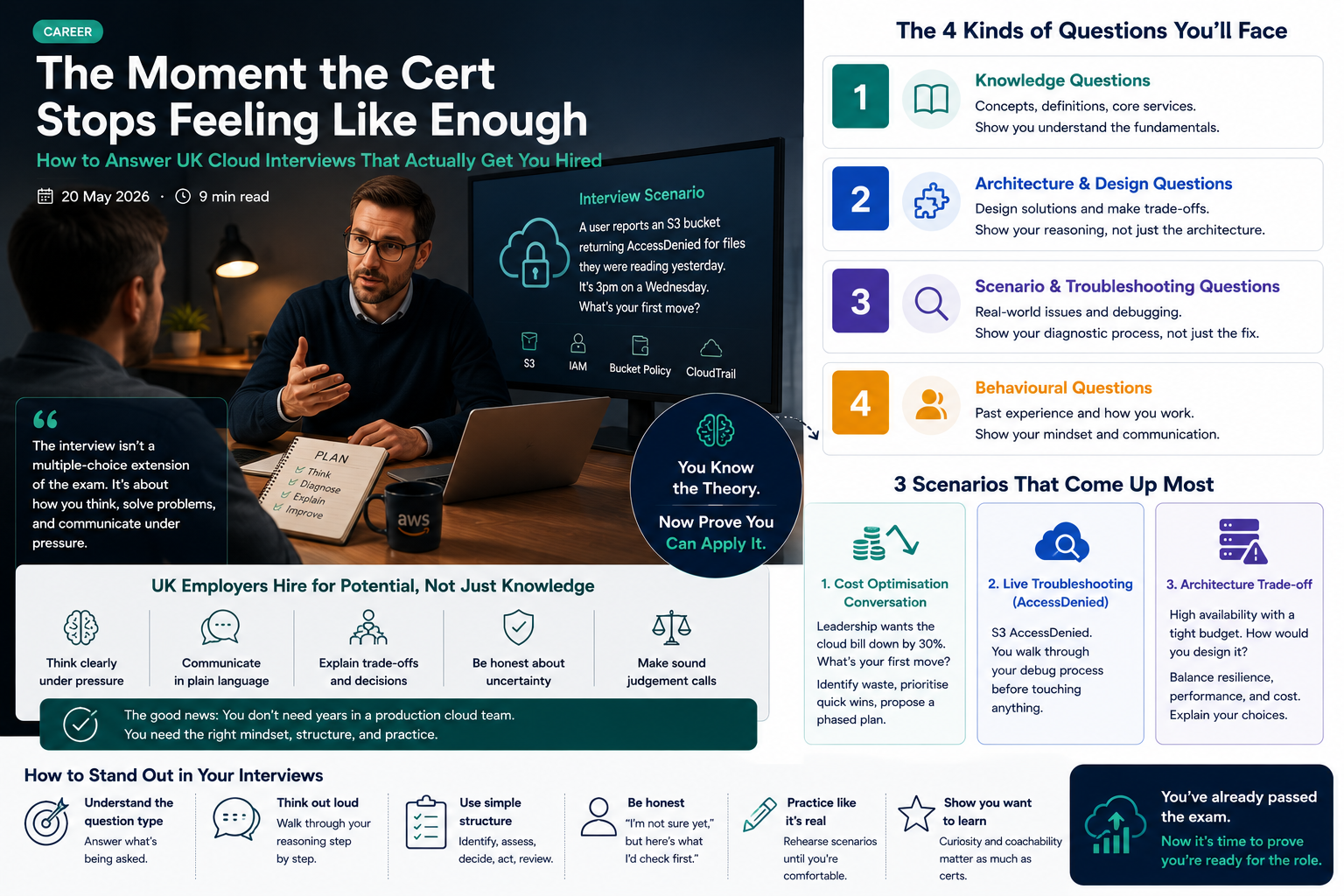
The moment the cert stops feeling like enough
The result email lands. You passed AWS Cloud Practitioner. The badge is on your LinkedIn within the hour. You start applying for junior cloud roles. Three days later you're in your first interview, twenty minutes in, the polite small-talk done, when the hiring manager leans forward and says: "Walk me through how you'd troubleshoot this. A user reports an S3 bucket returning AccessDenied for files they were reading yesterday. It's 3pm on a Wednesday. What's your first move?"
And in that exact second, the gap between "I know what S3 is" and "I can debug a live access issue" hits you all at once. Your brain runs through the IAM and bucket policy domains you crammed for two weeks. None of it is shaped like the question. You start a sentence. You're not sure where it's going.
This is the moment most Cloud Practitioner holders crash their first interview. Not because they don't know enough. Because nobody told them the interview wasn't going to be a multiple-choice extension of the exam.
Why Cloud Practitioner holders freeze, when they don't need to
Cloud Practitioner is a foundational cert. Domains around cloud concepts, security, technology, billing. What it isn't is a rehearsal of the situations UK cloud interviewers will put you in. Hiring managers know the cert proves you know the language. They want to find out whether you can reason about an architecture trade-off, walk through a troubleshooting scenario without panicking, and explain a cost decision to a senior leader who doesn't share your vocabulary. The exam doesn't test for that. The interview does.
The good news is the gap is bridgeable. You don't need three years in a production cloud team to answer well. You need to know what kind of question you're being asked, what the interviewer is really testing, and how to think out loud in a way that signals you'd be useful in the room when something breaks.
UK cloud interviewers, especially for entry and junior roles, aren't trying to catch you out on services you've never used. They're trying to find out whether you'd be structured, methodical, and honest about uncertainty when a real ticket lands. "I'm not sure yet, but here's what I'd want to check first" beats a wrong answer delivered confidently every time.
The four kinds of question UK cloud interviewers actually ask
If you've never done a cloud interview before, here's the shape. Most UK entry and junior cloud interviews mix four question types. They weight the middle two most heavily.
1. Knowledge questions. "Explain the shared responsibility model." "What's the difference between S3 and EBS?" "When would you reach for Lambda over EC2?" These are the easiest to revise for and the cheapest to test, so they show up at the start of the interview. Don't recite the AWS docs back. Define the concept in your own words, give one practical example, move on. Showing you can translate the textbook into plain language is what they want.
2. Architecture and design questions. "Walk me through how you'd host a low-traffic marketing site on AWS." "We need to make this internal API available to a partner. How would you set that up?" This is where most candidates either overengineer or freeze. The trap is reaching for the most sophisticated answer ("I'd use CloudFront with Lambda@Edge and a multi-region replicated DynamoDB..."). The move is to think out loud about trade-offs: what's the simplest thing that would work, what does it cost roughly, what would break first, what would you add if the requirements grew. Show the reasoning, not just the architecture.
3. Scenario and troubleshooting questions. "A user reports an S3 AccessDenied for files they were reading yesterday. Walk me through your debug." "An EC2 instance won't start. Where do you look?" "A Lambda is timing out. What's your first check?" These are testing whether you have an actual investigative instinct. The wrong answer is jumping straight to a fix ("I'd update the bucket policy"). The right answer names what you'd want to know first (did the policy change recently, is it just this user or everyone, is the file definitely there), what you'd check in CloudTrail or the policy simulator, and how you'd narrow it down before changing anything in production. Show the diagnostic shape, not the headline solution.
4. Behavioural questions. "Tell me about a time you had to learn a new technology under pressure." "Tell me about a time you delivered bad news to a senior stakeholder." If you're a career changer with no production cloud history, you're answering these from your previous career, and that's both allowed and expected. We've gone deeper on how to answer "tell me about a time" questions when you don't yet have the experience in another piece if that's the gap you're staring at.
The three scenarios that come up most
If you walk into a UK cloud interview having mentally rehearsed three specific scenarios, you'll handle most of what gets thrown at you. The three:
The cost optimisation conversation. "A senior leader has just told you the cloud bill needs to come down by 30% by the end of next month. What's your first move?" The interviewer wants to see whether you'd panic-delete things (no), whether you'd start with workload understanding before cuts (yes), and whether you know what usually wastes money in AWS environments. Your answer should walk through: pulling the Cost Explorer breakdown, identifying the top three services by spend, checking for obvious waste (idle EC2 instances, oversized RDS, untagged resources, lifecycle-less S3, dev environments running 24/7), then proposing a phased plan rather than a single big cut. Naming Compute Savings Plans, Reserved Instances and Spot for the right workloads earns extra credit.
Live troubleshooting. "S3 AccessDenied, walk me through it." Variations include EC2 won't start, Lambda's timing out, an API Gateway returning 5xx. The interviewer wants to see your investigative shape. Your answer should run identify (is it reproducible, is it everyone or one user, when did it start), narrow (recent IAM or bucket policy changes, CloudTrail events, the policy simulator), and only then act (test the smallest possible change, in a non-production scope if available). Naming the tools (CloudTrail, the IAM policy simulator, CloudWatch Logs, X-Ray for distributed services) signals you've actually opened the console at least.
Architecture trade-off. "How would you make this multi-region for availability?" The interviewer is testing whether you'll reach for "yes, here's the full Well-Architected diagram" without asking what the actual availability requirement is. The right answer names the trade-offs before naming the design: cost (multi-region is expensive), data consistency (replication has latency, can the app tolerate it), failover automation (Route 53 health checks versus manual), and the cheaper alternative (multi-AZ in one region is usually plenty for most workloads). Show you understand that "make it more available" is a business conversation, not a technical one.
The "real production cloud experience" question, when you haven't yet
This is the one Cloud Practitioner holders fear most. "Tell me about a time you've worked on a real production cloud system." You panic because there isn't one yet. There doesn't need to be. You have three honest moves.
The first is to translate. You have absolutely encountered systems-administration situations in your prior work, even if they weren't labelled as cloud. The day you helped a colleague restore an accidentally deleted file. The on-call shift where you triaged a ticket queue. The time you spotted that the office Wi-Fi config was wrong before anyone noticed. These translate, especially the reasoning patterns (identify, contain, fix, communicate). Talk about them as such.
The second is to use deliberate practice. AWS Free Tier gives you twelve months of meaningful headroom to build real things. A static site hosted on S3 with CloudFront in front. A small Lambda that responds to S3 uploads. A VPC with public and private subnets and a working bastion host. These are weekend-scale projects, but you can talk about them with specificity. "I built a static portfolio site on S3 and ran into a CORS issue with the API Gateway endpoint, here's what I learned about preflight requests" is a credible, honest answer.
The third is to lean on rehearsed scenarios. If you've walked through, properly and out loud, how you'd handle the three scenarios above, you have worked through them, even if only in rehearsal. Hiring managers know what cert-only candidates sound like. They also know what rehearsed candidates sound like. The second group consistently outperforms the first.
The candidate who walks into a cloud interview having actually built two or three small things in the Free Tier, and is willing to talk about what broke, will outperform the candidate who's only got the cert. Almost every time. The first salary the second candidate is offered usually reflects the gap.
Where Aris fits in
Aris is honest about what's in its lane and what isn't. AWS AI Cloud Practitioner sits in Aris's curated library and is taught through real conversation rather than lecture videos. For the hands-on lab work that Associate-level interviews increasingly ask about, the AWS Free Tier and Skill Builder are where you should spend that time. Aris won't pretend to replace them.
Where Aris does meaningfully close the gap is the conversation side of cloud. Voice-based simulations of the architecture trade-off discussion, the cost conversation with a senior leader, the troubleshooting walk-through an interviewer wants you to talk through out loud. You practise the conversation, Aris scores you on how you handled it, then you do it again. By the time you walk into the first interview, you've already had the difficult version of the conversation more than once. UK hiring managers can hear the difference inside thirty seconds.
You don't strictly need Aris to make this work. You can roleplay with a friend who's worked in cloud, find a mentor through a community, or pair with another cert-holder for mutual interview prep. The rule isn't where the practice happens. The rule is that it happens before the interview, not in it.
The honest takeaway
AWS Cloud Practitioner gets you to the CV-filter side of the door for junior and entry-level cloud roles. The interview decides whether you walk through it. UK hiring managers don't expect first-job candidates to have years of production AWS. They do expect candidates to be structured, methodical, and honest about uncertainty when a scenario lands. That part isn't a knowledge problem. It's a rehearsal problem.
Rehearse the three scenarios. Build two or three small projects in the Free Tier and be ready to talk about what broke. Translate the systems-admin situations you've already lived through. Practise saying the words out loud before they count. The first cloud job in the UK has gone to candidates who've done less than that. It's well within your reach. If you're still weighing which AWS cert to start with, we've broken that down in a separate piece, and the wider list of certs UK employers actually hire for sits next to it.
Don't just pass the cert. Walk into the cloud interview ready.
Study, practise, and advance with Aris.
Join the waitlistReferences
- AWS Certified Cloud Practitioner exam: aws.amazon.com
- UK cloud engineer salary data: itjobswatch.co.uk
- AWS Free Tier (12 months): aws.amazon.com/free