Is PRINCE2 Worth It in 2026? UK Salary Data, Costs, and Career Impact
The short answer
If you're working in or trying to break into project management in the UK, PRINCE2 is almost certainly worth it. It's the certification that shows up on more UK PM job postings than any other, and the salary data backs it up.
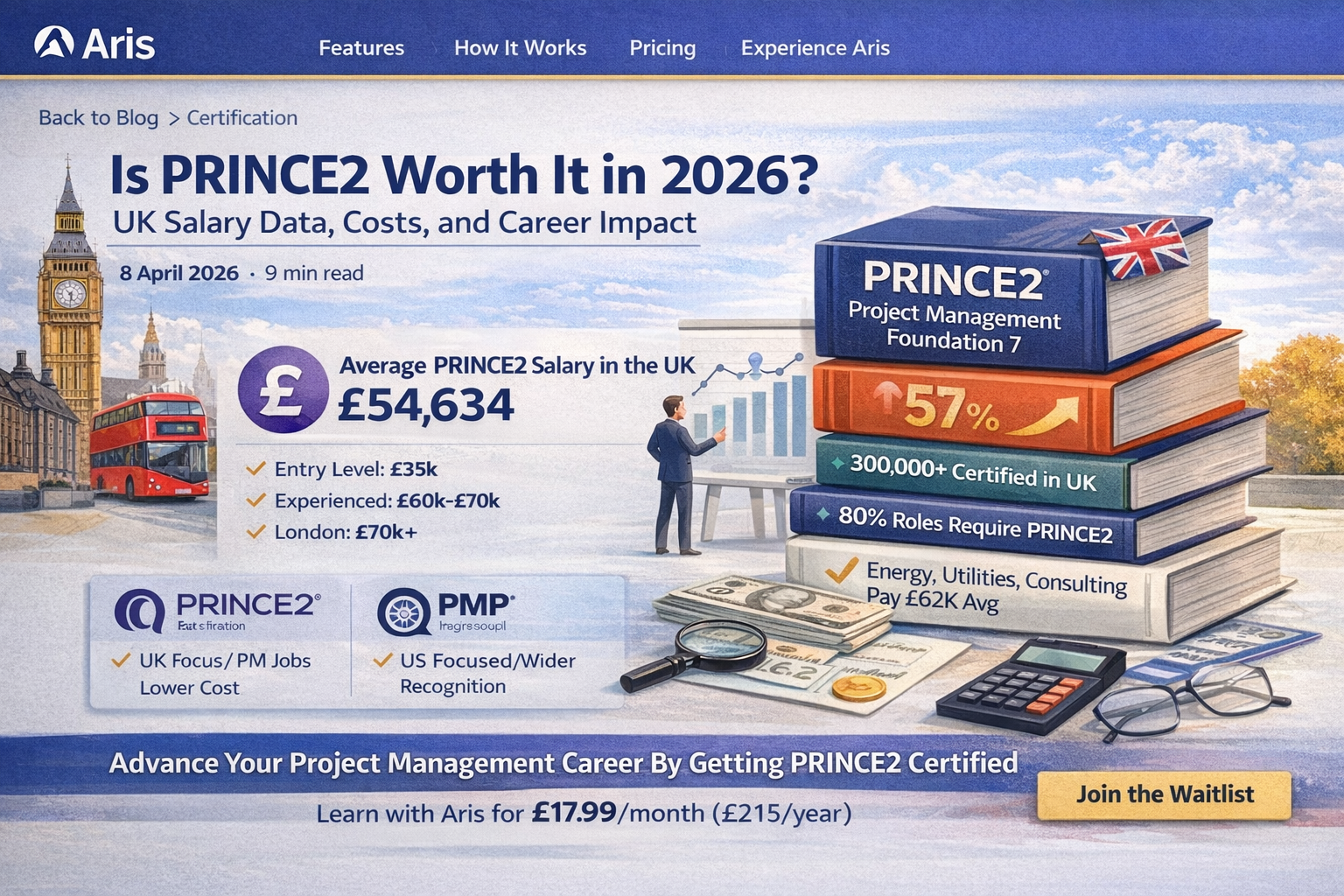
PRINCE2 holders in the UK earn an average of £54,634, 57% above the national average. The APM Salary and Market Trends Survey 2025 found project professionals' average salary rose 10% to £52,500, with 80% saying they're satisfied in their current role.
But let's be honest about it. "Worth it" depends on where you're heading. If you're targeting UK project management, IT delivery, or change management roles, PRINCE2 is close to non-negotiable. If you're focused on North America or working in a purely agile environment with no governance layer, your money might be better spent elsewhere.
What is PRINCE2, really?
You'll find definitions online that say things like "a structured project management methodology providing a complete governance framework." Which is accurate, but doesn't actually tell you what it feels like to use it.
In practice, PRINCE2 gives you a common language and a set of guardrails for running projects. It defines who's responsible for what, when decisions need to be made, and how to keep things on track when they start going sideways (which they always do). It's used by IBM, HSBC, the UK government, and the UN. It works for a two-person internal project or a multi-million-pound programme.
If you've heard people call PRINCE2 "too rigid" or "too bureaucratic," that was a fair criticism of older versions. PRINCE2 7 tackled that head-on.
What actually changed with PRINCE2 7?
PRINCE2 7 launched in September 2023 and it was the biggest overhaul the methodology has ever had. The main changes:
- People actually matter now: Previous versions were criticised for treating projects like process machines and ignoring the humans doing the work. Version 7 puts team leadership, stakeholder engagement, and people management front and centre.
- Sustainability is baked in: Not as a buzzword, but as a genuine consideration in project decisions.
- Digital and AI guidance: Acknowledgement that projects in 2026 involve digital tools, data, and increasingly AI.
- Less rigidity: Easier to tailor to different organisations and project types. The old "you must follow every process" criticism doesn't hold up anymore.
So the methodology has improved. But what about the price?
What will PRINCE2 actually cost you?
Direct from PeopleCert: £543 (course + exam bundle, including VAT)
UK training providers: £800-£1,500 (instructor-led, includes exam)
Self-study: Under £500 (manual + exam voucher)
For context, PMP from PMI costs $555 USD for the exam alone, plus $139/year for PMI membership, plus £1,500-£2,500 for UK classroom training. PRINCE2 is generally the cheaper option. For a detailed breakdown of all the costs involved, see our UK certification cost guide.
One thing to watch: PeopleCert charges a £60 fee if you need to reschedule. So book your exam date when you're actually ready, not when you're feeling optimistic.
What will you earn with PRINCE2?
The salary data is consistently strong across experience levels:
- Entry level: £35,000
- Average: £54,634
- Experienced (5+ years): £60,000-£70,000
- London and South East: Over £70,000
The APM survey found that energy, utilities, and consultancy sectors pay the highest PM salaries at £62,500 on average. And 82% of project professionals said salary is the most important factor when looking for new roles. So the market is competitive, and certified candidates have a clear advantage.
Here's something interesting: holding PRINCE2 alongside a technical certification (like AWS or Security+) creates a compound effect. UK job board data suggests dual certifications across governance and platform can boost salary offers by roughly 40%. See our guide to the certifications UK employers are actually hiring for if you're thinking about what to pair it with.
Of course, before you think about pairing certifications, you need to pick the right one to start with. And the question most people ask first is whether PRINCE2 or PMP is the better choice.
PRINCE2 or PMP?
If you're in the UK, get PRINCE2. That's the honest answer. It appears more frequently on UK job postings, it's required for most public sector PM roles, and it's what UK hiring managers expect to see.
If you're targeting the US or working for a global company based in North America, PMP has wider recognition there. And if you're senior enough, many employers expect both. But if you're choosing one and you're UK-based, PRINCE2 is the one that opens doors here.
Who benefits most from PRINCE2?
It's a strong fit if you're:
- A project manager or aspiring PM targeting UK employers
- A business analyst involved in project delivery
- Moving from a technical role into management or delivery
- Working in change management or programme coordination
- Consulting for UK public sector clients (where PRINCE2 is often mandatory)
It's probably not worth it if you're in a pure software development role with no governance layer, or if your career is focused entirely outside the UK and Europe.
How to actually prepare
The Foundation exam is 60 multiple-choice questions with a 55% pass mark (33 out of 60). Most people study for 2-4 weeks. It tests your knowledge of the methodology, not your ability to apply it in practice.
That distinction matters. You can pass the exam by understanding the principles and themes. Understanding the principles doesn't mean you can manage a real stakeholder who's pushing back, handle scope creep on a live project, or walk into an interview and demonstrate you know what you're doing. We've broken down the 12 PM interview questions UK hiring managers actually ask in a separate piece if that's where you're heading next.
Traditional classroom courses give you 2-3 days of instruction then send you off to sit the exam. Self-study gets you through the material but you're on your own for structure and motivation. Either way, make sure your materials cover PRINCE2 7, not the older edition.
Aris takes a different approach. Instead of watching videos or reading slides, you learn through real conversation, with Aris adjusting to where you are. When you want to build confidence beyond the theory, you can step into workplace scenarios and practise the kinds of stakeholder conversations and decisions you'll face in the role. Aris covers every certification in the curated library, so once you're done with PRINCE2, you can pick up AWS or Security+ without paying anything extra.
Whichever route you choose, focus on understanding the principles rather than memorising process diagrams. PRINCE2 7 rewards practical understanding.
References
- APM Salary and Market Trends Survey 2025: apm.org.uk
- PeopleCert PRINCE2 7 announcement: peoplecert.org
- PeopleCert PRINCE2 Foundation pricing: peoplecert.org
- UK certification salary data: upgrademyskill.com