Made Redundant? How to Reskill Into a Tech Role in Six Months (UK Playbook)
The day everything changes
Tuesday morning. The meeting in the small room with the line manager and somebody from HR. The phrase "your role has been impacted" sitting in the air between you. The walk back to your desk, picking up the things from your drawer. The walk to the car park afterwards. The conversation with your partner that evening. The maths at the kitchen table that night, working out how long the severance covers the mortgage.
If that's where you're standing right now, this isn't going to fix the morning you've had. What it might do is give you the shape of what good actually looks like from here, because there is a shape and it's more reachable than it feels at 11pm on the worst day of your year.
Redundancy isn't a verdict on you
Q4 2025 saw around 145,000 redundancies in the UK. Q1 2026 wasn't much quieter. Whole teams have gone, in industries that looked stable in January and didn't make it to spring. Most of the people in that number were good at their jobs. The cuts happened anyway, because of restructures and currency moves and AI shifts and a hundred other things that have nothing to do with whether you were doing your work properly.
The internal monologue that says "I should have seen this coming" is almost always wrong. The one that says "I should be using this time better" is also wrong, at least for the first fortnight. Take the time. Then come back.
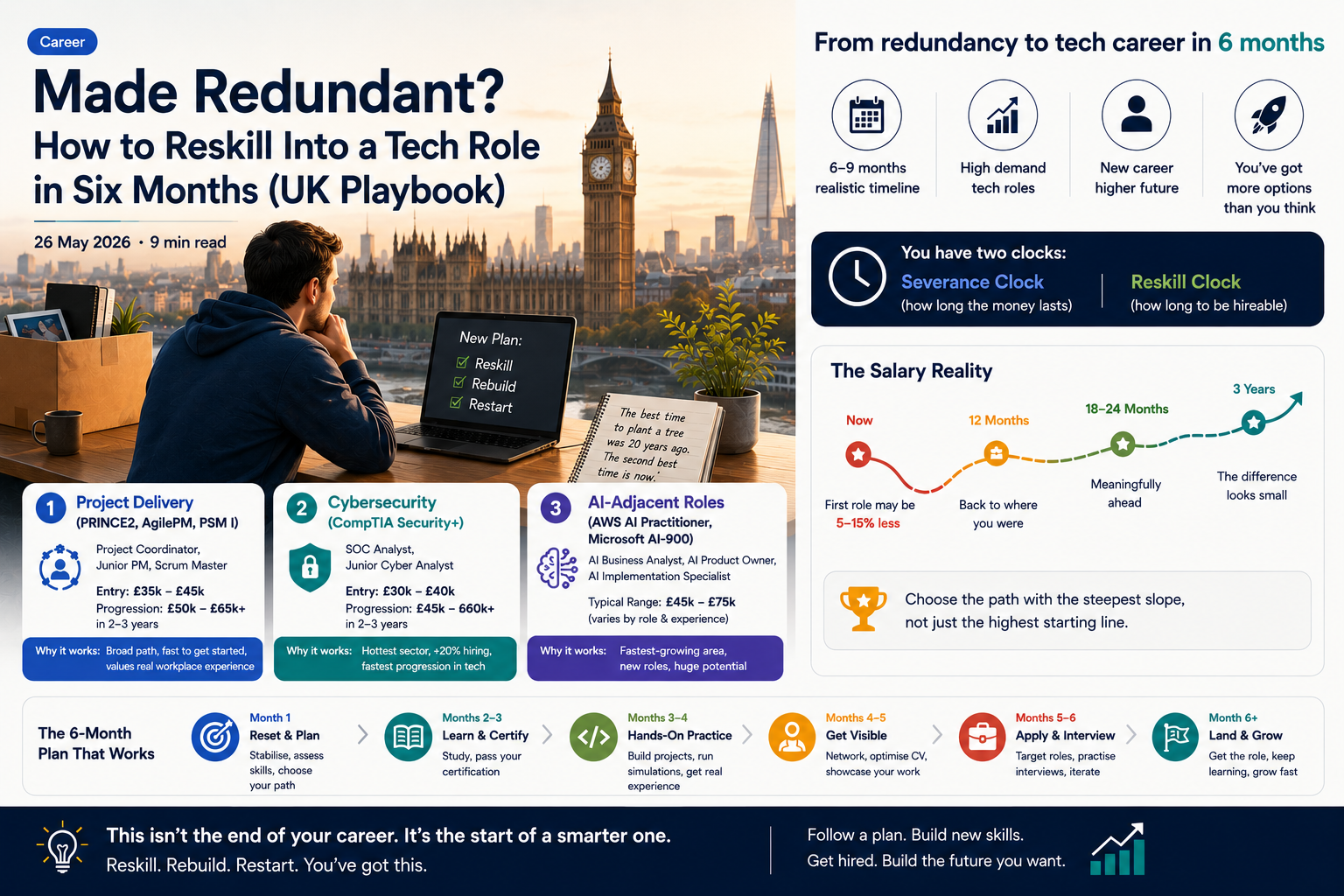
The most useful thing to know in the first month is that you have two clocks, not one. The severance clock (how long the money lasts) and the reskill clock (how long it'll take to be credibly hireable into a new role). They're different lengths and they don't run at the same speed. Most of the bad decisions in this period come from confusing the two.
Why six months, not twelve weeks
The career-change content online splits roughly into two camps. The cheerful camp tells you you can be in a new tech role in 12 weeks if you commit. The realistic camp says it'll take a year or more. The honest answer, from watching plenty of people do this, is six to nine months for most tech-adjacent professional roles.
Twelve-week timelines work for some people. Usually they're in their early 20s with no dependents, the right pre-existing skills, and the right luck. For most people in their 30s and 40s in the UK, with a partner and a mortgage and possibly kids, twelve weeks is a marketing number. Six to nine months is the realistic horizon, and you can survive on most severance packages comfortably inside that window if the spending is conservative.
The three viable paths inside six months
If you're starting from a non-technical professional background, three paths consistently work for UK career changers inside the six to nine month horizon.
Project delivery (PRINCE2, AgilePM, PSM I). This is the broadest path and the one most career changers land on. Project coordinator, junior project manager, and scrum master roles open at £35,000 to £45,000 entry, with quick progression into the £50,000 to £65,000 band over the following two to three years. The certifications are affordable: PRINCE2 Foundation at around £543 direct, AgilePM at around £300, PSM I at $200. You can credibly hold one of these in eight to twelve weeks of evening study and start applying. UK delivery roles value real workplace experience, which most career changers from other fields already have plenty of.
Cybersecurity (Security+). The hottest sector in UK May 2026, with hiring up around 20% year on year. CompTIA Security+ at £164 is the cheapest doorway in tech. Entry SOC and junior cyber analyst roles start at £30,000 to £40,000, with mid-level (year two to three) at £45,000 to £60,000. Shift work for SOC roles isn't for everyone, but progression is faster than almost anywhere else in tech. We've gone deeper on what the salary trajectory actually looks like in this piece.
AI-adjacent business roles (AWS AI Practitioner, Microsoft AI-900). The newest of the three, and the fastest-moving. Most large UK employers are hiring for AI-aware business analysts, AI-adjacent product owners, AI implementation roles, and "AI champions" inside existing functions. AWS AI Cloud Practitioner at around £80 and Microsoft AI-900 at around £100 are the doorway credentials. Salaries vary wildly because the roles are new and not yet standardised, but £45,000 to £75,000 is the typical range for someone bringing prior professional experience plus the cert.
The bit nobody mentions about the salary
The salary maths after redundancy is the part that quietly stops a lot of career changers. Here's the honest version. The first new role after a career change sometimes pays slightly less than what you were earning before. Five to fifteen percent below is normal for people moving into entry-level tech-adjacent roles from a mid-career non-tech job. That feels like a step backward, and in the literal sense, for month one, it is.
What usually happens after that: twelve months in, you're back to where you were. Eighteen to twenty-four months in, you're meaningfully ahead, because tech-adjacent roles tend to climb faster than the role you came from. Three years in, the difference is enough that the original dip looks small. The trick is knowing the dip is coming, not being surprised by it, and choosing the path with the steepest slope rather than the highest starting line.
Some moves don't dip at all. Customer success manager and implementation consultant roles often start at or above where mid-career professionals were earning, because they value account management, communication, and stakeholder experience more than cert depth. If those words describe your previous work, those paths deserve serious consideration.
The six-month plan that actually works
Not a literal calendar. The rough shape of the work, which most successful UK career changers after redundancy do something close to.
Weeks 1-3: Recover and decide. Two weeks off. Genuinely. Then pick one path from the three above. The biggest mistake people make here is trying to optimise too hard between options and ending up choosing nothing. Pick the one that fits where you've been and where you want to go, even if the data says the other one earns slightly more. Conviction beats marginal salary uplift, every time.
Weeks 4-12: Earn the cert. Eight to twelve weeks of focused evening study, with the exam booked at the back end. Don't pay for a £1,500 classroom course. Use a structured study tool, free resources, and the official cert materials. Save the severance.
Weeks 8-16: Practise the role. Overlap with the study phase. This is where the gap between certified and hireable closes. Workplace scenario practice (stakeholder conversations, incident triage for cyber, sprint conflict for scrum, project recovery for PM) is the single most useful thing you can do for the interview that's coming. We've written a longer piece on why the cert is only half the battle if you want to go deeper.
Weeks 12-20: Apply. Start earlier than you feel ready. The first applications teach you what the market wants in ways you can't predict from the inside. Most successful career changers send fifty to a hundred applications before they land the offer. That's normal. It doesn't mean anything's wrong.
Weeks 16-26: Interview, decide, start. Most offers come from interviews you almost talked yourself out of. The interview prep itself is where the rehearsal pays off. By the time you're sitting opposite a hiring manager, you've already had the difficult conversation a few times, even if only with a tool or a friend or a mentor.
Severance budget guidance, plainly. Spend less than 20% of it on the reskill itself. A cert, a structured study tool, a coach or interview practice. The rest is your runway. People who blow half their severance on a £3,000 bootcamp and then can't pay rent at month four end up taking the first offer they get, which is rarely the best one.
Where Aris fits in
The reason we built Aris is the exact problem redundancy puts in front of you. Classroom courses that cost £1,500 to £3,000 work, but they eat the severance and they teach the framework without rehearsing the role. The free YouTube content is brilliant for parts of the study but doesn't build the muscle for the actual conversations the new job will demand. Aris sits between those two: real conversational teaching for the cert, plus voice-based simulations of the workplace situations the role involves, plus interview rehearsal tuned to the actual job description, on a subscription that's a fraction of what classroom training costs.
You don't strictly need Aris to do this. You do need to do all three pieces, somewhere, with something. Wherever the practice and the rehearsal happens, just make sure it happens, and make sure it happens before the first interview rather than during it.
The honest takeaway
Redundancy isn't fair, and the version of yourself that came out of that meeting on Tuesday morning isn't who you want to be making decisions from. Take a fortnight. Pick a path. Earn the cert. Practise the role. Rehearse the interview. Apply earlier than you feel ready. Six to nine months later, you're starting something different, and within a couple of years, almost certainly something better-paid than the role you lost.
You're not the first person to make this move. The path is well-worn. We've written a fuller piece on making a career change at 30+ in the UK if you want a longer read on the shape of it. Start.
Six months. One cert. A real shot at a better role.
Study, practise, and advance with Aris.
Join the waitlistReferences
- UK ONS labour market overview: ons.gov.uk
- UK redundancy statistics: gov.uk
- PRINCE2 Foundation pricing: peoplecert.org
- CompTIA Security+ UK pricing: uk-academic-store.comptia.org