Scrum Master Interview Questions UK 2026: How to Answer Them Well
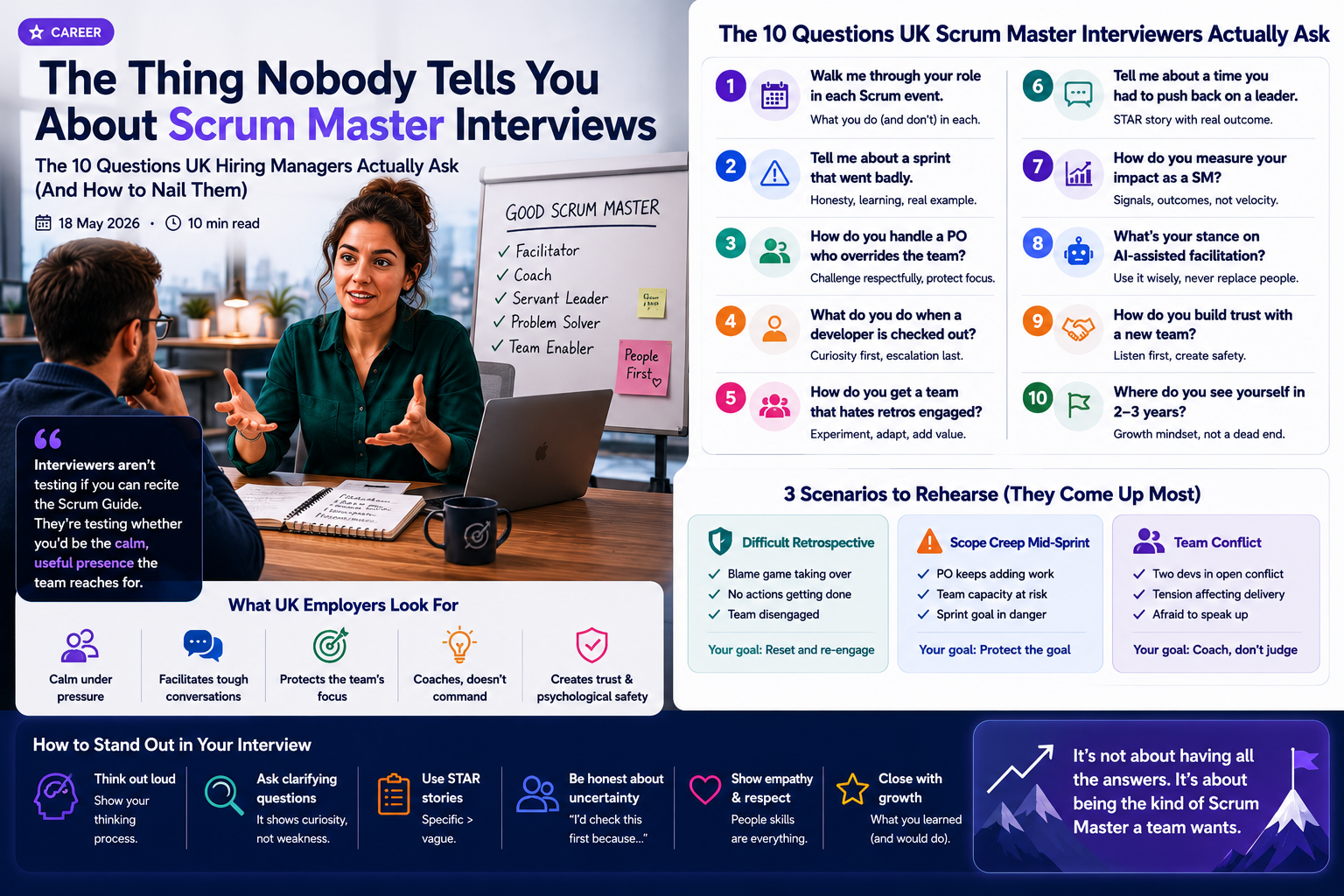
The thing nobody tells you about Scrum Master interviews
You can pass PSM I. You can have the Scrum Guide near-memorised. The Scrum Master interview is a different test. UK hiring managers aren't really asking whether you know the framework. They're trying to work out whether you'd be the calm, useful presence the team and the Product Owner both reach for when something starts going wrong.
That's actually a relief, once you see it. You don't have to recite the events of Scrum in order. You have to sound like someone who would walk into a stand-up that's gone sideways and quietly make it useful again.
Why PSM I holders freeze in interviews, when they don't need to
PSM I is a knowledge cert. Scrum theory, accountabilities, events, artefacts, plus enough applied reasoning to keep the pass mark honest. What it isn't is a rehearsal of the conversations a Scrum Master will actually be paid to have. Hiring managers know the cert proves you understand the framework. They want to find out whether you can facilitate a tense retrospective, push back on a Product Owner without picking a fight, and coach a team through a sprint that's slipping without becoming the bottleneck yourself. The exam doesn't test for that. The interview does.
The good news is the gap is bridgeable. You don't need three years on a Scrum team to answer well. You need to know what's actually being asked behind each question, and how to think about it out loud in a way that signals you'd be useful, not just informed.
UK Scrum Master interviewers, especially for first and second roles, aren't trying to test whether you can recite the Scrum Guide. They're trying to find out whether you'd be calm, structured, and curious about people when a real team conflict lands. The best answers in these interviews are usually the most honest ones. "I'd want to understand what's actually going on first" beats a textbook escalation path every time.
The 10 questions UK Scrum Master interviewers actually ask
If you've never done a Scrum Master interview before, here's the shape. Most UK entry and mid-level Scrum Master interviews mix framework, scenario, behavioural and (now, in 2026) AI-related questions. The ten that come up most:
1. "Walk me through your role in each Scrum event." A warm-up, but underrated. Most candidates list the events and stop. Strong answer: name each event, name what you're actually doing inside it (and what you're not), and name one common failure mode you'd watch for. Showing you understand the difference between attending the event and facilitating it is what they want.
2. "Tell me about a sprint that went badly." The killer. The candidate who claims their sprints have all gone smoothly is the candidate who's never actually facilitated one. Pick a real example, a side project, a study cohort, a community event you ran. Be specific about what went wrong. Take responsibility for your part. End with what you actually changed in the next sprint as a result. The point isn't the failure. It's whether you can tell the truth about your own facilitation without flinching.
3. "How do you handle a Product Owner who keeps overriding the team's commitments mid-sprint?" Behavioural and political. They want to see whether you can challenge a Product Owner without sounding either cowardly or aggressive. The wrong answer is "I'd remind them of the Scrum Guide". The right answer names the conversation you'd have privately, the data you'd want to show them (often a delivery trend, not a principle), and the third option you'd offer (the right sprint goal, a sprint cancellation if it's truly that bad). Show you respect the Product Owner's accountability while protecting the team's focus.
4. "What do you do when a developer is quietly checked out of every stand-up?" People management at its quietest. Don't say "I'd escalate to the line manager" as your first move. That makes you sound like the kind of Scrum Master nobody wants to work for. Real answer: have the private one-to-one, framed as curiosity rather than judgement. Often there's something going on you don't know about. If the conversation doesn't land, then yes, the line manager. Not as the opening play.
5. "How would you coach a team that doesn't want to do retros any more?" Facilitation skill, plus humility. The wrong answer is forcing the retro through. The right answer is naming the symptom (the team isn't getting value from how the retro is currently run, which is on you), and then proposing one or two experiments. A different format, a different time, a different scope. Maybe a focused 20-minute version. Show you'd treat the retro as a service to the team, not a service to the framework.
6. "Tell me about a time you had to push back on a senior leader." The mature-Scrum-Master question. They want to see whether you'd have the conversation properly. Use the STAR shape if it helps. Pick a real example, name the leader's role rather than their name, describe the disagreement specifically, and crucially, end with what happened next. Did you change their mind. Did they overrule you and the team paid for it. Did you find a third option. The richer the resolution, the better.
7. "How do you measure your own impact as a Scrum Master?" Depth question. Most candidates blank or default to "velocity". Strong answer names a small set of signals you'd watch (team-set goal hit rate, retrospective action follow-through, dependency resolution time, team-reported psychological safety), explicitly disclaims velocity as a measure of your own impact, and notes that the best signal is usually whether the team actually needs you less over time. The point of a good Scrum Master is to do themselves out of a job, slowly.
8. "What's your stance on AI-assisted facilitation?" The 2026 question. Increasingly common, and most candidates default to a confused answer. The right answer is a thoughtful position rather than dogma. Helpful for some things (drafting retro notes, summarising sprint outcomes for stakeholders, generating prompts for facilitation experiments), not a replacement for the human read of a team. Name where you'd use it, where you wouldn't, and why. Hiring managers in 2026 are testing whether you've thought about this rather than ignored it.
9. "How do you handle a stakeholder who keeps pressuring the team to add scope mid-sprint?" Scope creep is the perennial Scrum Master pain. The wrong answer is "I refer them to the change control process". The right answer names the conversation you'd have with the stakeholder (often together with the Product Owner), the trade-off you'd make visible (what gets de-prioritised if this gets added), and the moment you'd hold the line. Most senior stakeholders quietly stop pushing once they see what their request actually costs.
10. "Why this team, and why now?" The closer. Most candidates blow this by reciting the job description back at the interviewer. Strong answer: name two specific things about this team or this product that aren't in the JD (you researched the company, you spoke to someone who works there, you know what their last project failure was), and one specific thing about your own trajectory that makes the timing right for both sides. Specificity wins. Generic "I'm passionate about agile" loses every time.
The three scenarios that come up most
Behind the ten questions, three specific scenarios show up in UK Scrum Master interviews more than any others. Rehearse these three out loud and you'll handle most of what gets thrown at you.
The disengaged developer. One person on the team has been quiet for three sprints. They're hitting their commitments but not contributing in events. What do you do? Interviewers want to see whether you'd go straight for the line manager (no), whether you'd treat it as a one-to-one conversation first (yes), and whether you'd suspect something larger (a stuck career conversation, burnout, a personal issue, an unspoken disagreement with the Product Owner). Show curiosity, not policy.
The mid-sprint scope push. A stakeholder turns up to the team's chat asking for "just a small addition" mid-sprint. The Product Owner is on leave. The developers look at you. The interviewer wants to see whether you'd say yes (no), whether you'd flatly say no (also no), and whether you'd protect the team by deferring the decision properly. The right move is naming what would have to be de-prioritised, suggesting a focused conversation with the PO when they're back (or the deputy if there is one), and offering to capture the request properly in the meantime so nothing gets lost.
The sprint that's slipping with three days left. Day eight of a ten-day sprint. Two of the four committed items are at risk. The team's quietly tense. The interviewer wants to see whether you'd reach for a facilitation move (a focused mid-sprint sync, not a panic), whether you'd help the team make the explicit decision (drop the lower-value item now, defend the rest), and whether you'd protect the team from a stakeholder pile-on while the work finishes. Show you'd treat the situation as a normal sprint event, not a crisis.
The "real Scrum team experience" question, when you haven't yet
This is the one PSM I holders fear most. "Tell me about a real Scrum team you've facilitated." You panic because there isn't one yet. There doesn't need to be. You have three honest moves.
The first is to translate. You have almost certainly facilitated meetings, run study groups, chaired community events, or coached peers through difficult work. These are facilitation experiences. The skills (reading the room, surfacing the unspoken, holding space without dominating) are the same skills a Scrum Master uses. Talk about them as such.
The second is to use deliberate practice. Scrum.org's Open Assessments are free and excellent for sharpening your reasoning. Online agile communities and study cohorts let you facilitate at zero career risk. The agile slack and meetup scene in most UK cities has plenty of low-pressure facilitation opportunities. "I co-facilitated a learning cohort of eight people working towards PSM I" is a credible answer.
The third is to lean on rehearsed scenarios. If you've walked through, properly and out loud, how you'd handle the three scenarios above, you have worked through them, even if only in rehearsal. Hiring managers know what cert-only candidates sound like. They also know what rehearsed candidates sound like. The second group consistently gets the offer. If you're a career changer with no Scrum history at all, we've gone deeper on how to answer "tell me about a time" questions when you don't yet have the experience in another piece.
The Scrum Master who walks into the interview having actually facilitated something, even a study group, will outperform the one who's only revised the Scrum Guide. The interview is mostly a test of whether you can talk about facilitation like someone who has done it. Five rehearsed conversations is enough to sound like that, even if the team you facilitated was unofficial.
Where Aris fits in
Studying for PSM I gets you the framework. The interview tests something the framework doesn't rehearse you for. That's the gap we built Aris to close. Aris teaches PSM I through real conversation rather than cramming, and walks you through voice-based simulations of the facilitation conversations you'll actually face. The disengaged developer one-to-one. The Product Owner pushback. The retro that's gone stale and the team that's quietly done with them. You practise the conversation, Aris scores you on how you handled it, then you do it again. By the time you walk into the first interview, you've already held the difficult version of the conversation more than once. Hiring managers can hear the difference in the first thirty seconds.
You don't strictly need Aris to do this. You can pair with another PSM-bound candidate, find a community of agile practitioners willing to roleplay, or work with a mentor who's been a Scrum Master. The rule isn't where the rehearsal happens. The rule is that it happens before the interview, not in it.
The honest takeaway
Scrum Master interviews are won on three things: facilitation calm, willingness to take responsibility, and curiosity about people. The framework knowledge gets you to the room. The interview decides whether you walk out with the role. Hiring managers don't expect first-time candidates to have facilitated five teams. They do expect the candidate to sound like someone who has actually thought about the work, not just revised for the exam.
Rehearse the three scenarios. Translate the facilitation work you've already done. Practise saying the words out loud before they count. The first Scrum Master job in the UK has gone to candidates who've done less than that. It's well within reach. If you're weighing PSM I against other Scrum Master routes, we've covered the cert decision in a separate guide, and the PM interview format sits adjacent in our project manager interview piece if you're considering both paths.
Don't just pass PSM I. Walk into the Scrum Master interview ready.
Study, practise, and advance with Aris.
Join the waitlistReferences
- Scrum.org Professional Scrum Master I: scrum.org
- UK Scrum Master salary data: itjobswatch.co.uk
- Scrum.org Open Assessments: scrum.org/open-assessments