From Security+ to Your First Cyber Interview: What UK Hiring Managers Actually Ask
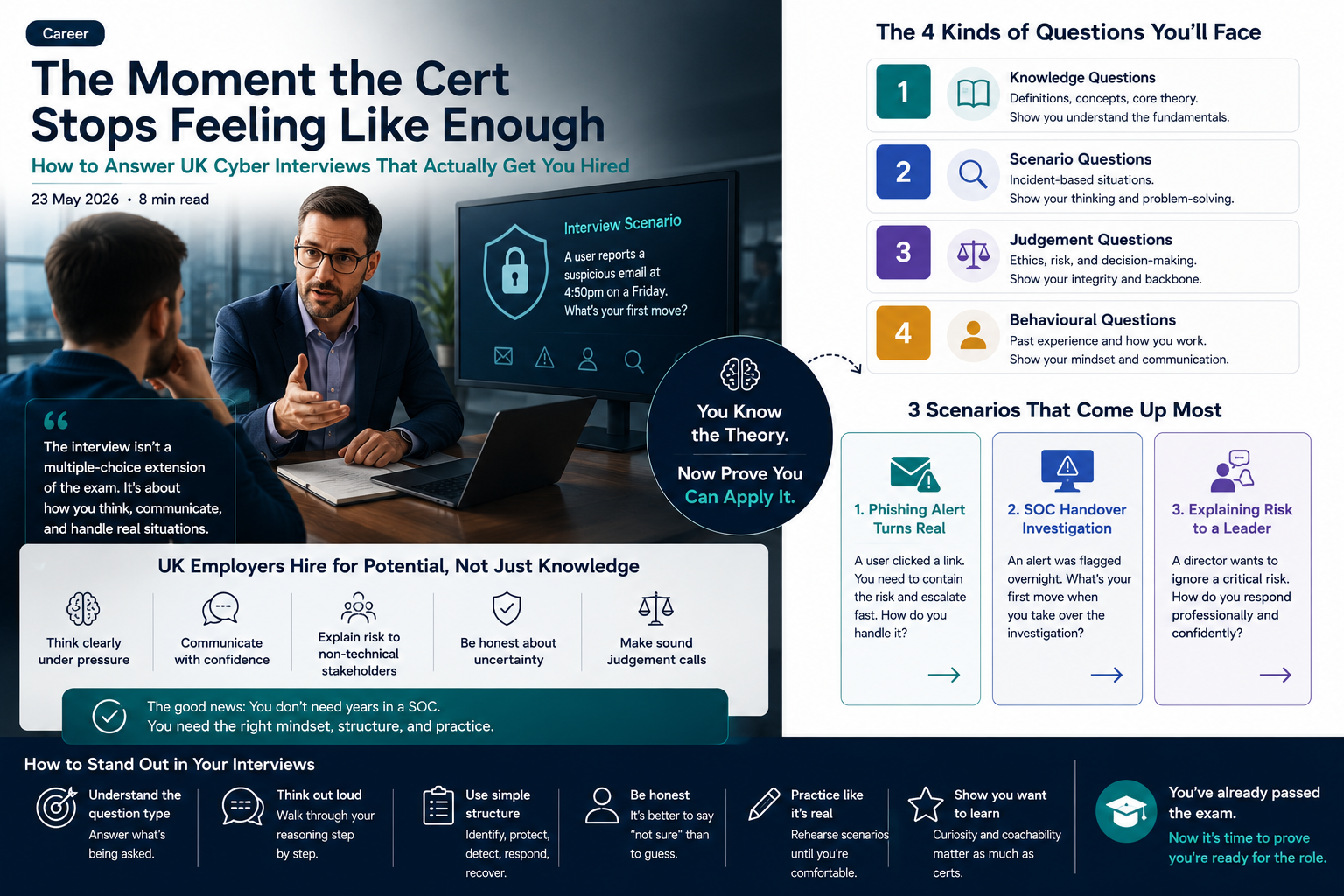
The moment the cert stops feeling like enough
You passed Security+. The result lands and you allow yourself a small private celebration. The cert is on your LinkedIn within the hour. You start applying. Three days later you're in your first interview, twenty minutes in, the polite small-talk done, when the hiring manager leans back and says: "Walk me through how you'd handle this. A user reports a suspicious email at 4:50pm on a Friday. What's your first move?"
And in that exact second, the gap between "I know what phishing is" and "I can run an incident triage" hits you all at once. Your brain runs through the framework you crammed for two months. None of it is shaped like the question. You start a sentence. You're not sure where it's going.
This is the moment most Security+ holders crash their first interview. Not because they don't know enough. Because nobody told them the interview wasn't going to be a multiple-choice extension of the exam.
Why Security+ holders freeze, when they don't need to
Security+ is a knowledge cert. Five domains, lots of vocabulary, a fair amount of decent scenario reasoning baked into the exam. What it isn't is a rehearsal of the actual situations UK cyber interviewers will put you in. Hiring managers know the cert proves you know the language. They want to find out whether you can think through a live incident, communicate calmly under pressure, and explain risk to people who don't share your vocabulary. The exam doesn't test for that. The interview does.
The good news is the gap is bridgeable. You don't need three years in a SOC to answer well. You need to know what kind of question you're being asked, what the interviewer is really testing, and how to think out loud in a way that signals you'd be useful in the room.
UK cyber interviewers, especially for entry and junior analyst roles, aren't trying to catch you out on what you don't know. They're trying to find out whether you'd be calm, structured, and honest about uncertainty when a real incident lands on your desk. Calm is more important than encyclopaedic. Structured beats fast. Honest about uncertainty beats faking confidence.
The four kinds of question UK cyber interviewers actually ask
If you've never done a cyber interview before, here's the shape. Most UK entry-level cyber interviews mix four question types. They weight the middle two most heavily.
1. Knowledge questions. "Define defence in depth." "Explain CIA." "Walk me through what TLS actually does." These are the easiest to revise for and the cheapest to test, so they show up at the start of the interview. Don't recite verbatim from your Security+ notes. Define it in your own words, give one practical example, move on. Showing you can translate the textbook into plain language is what they want.
2. Scenario questions. "A user reports a suspicious email at 4:50pm on a Friday. What's your first move?" "Your monitoring tool fires a low-confidence alert on a workstation accessing an unusual external IP. Walk me through your triage." This is where most candidates fall apart. The trap is rushing to the conclusion ("isolate the host"). The move is to think out loud: what do I want to know first, who do I want to talk to, what's the worst case here, what's the most likely case, what do I do in each scenario. Show the reasoning, not just the answer.
3. Judgement questions. "You think a senior leader is the source of a data leak. What do you do?" "Your manager tells you to close out an investigation because the affected system is going offline next week anyway. How do you handle it?" These are testing whether you have a spine. The wrong answer is "I'd follow the process". The right answer names the tension, names the stakeholder you'd talk to, and names the thing you would not do regardless of pressure.
4. Behavioural questions. "Tell me about a time you had to explain something technical to a non-technical person." "Tell me about a time you handled a stressful situation under pressure." If you're a career changer with no security history, you're answering these from your previous career, and that's both allowed and expected. We've gone deeper on how to answer "tell me about a time" questions when you don't yet have the experience in another piece if that's the gap you're staring at.
The three scenarios that come up most
If you walk into a cyber interview having mentally rehearsed three specific scenarios, you'll handle most of what gets thrown at you. The three:
The phishing alert that turns real. A user reports a suspicious email. You start triaging. As you dig, you realise they did actually click the link, two days ago, and they've been working off the same laptop ever since. The interviewer wants to see how you'd escalate the priority, what you'd contain, who you'd loop in, and how you'd communicate the bad news upward without panicking the room. Your answer should walk through identify, contain, eradicate, recover, and the people you'd call at each step.
The SOC handover with a half-finished investigation. You come into your morning shift. The night shift left you a ticket: a workstation flagged unusual outbound traffic at 2am, was isolated, the investigation paused. What's your first move? The interviewer wants to see whether you'd read the existing notes carefully before re-running anything (you should), whether you'd reach out to the night shift analyst for context if anything's unclear (you should), and whether you understand that continuity of evidence matters. SOC roles live and die on handover discipline.
Explaining risk to a senior leader who doesn't want to hear it. A director wants their team to keep using a legacy tool that has a known critical vulnerability. They tell you, in front of others, that your team is being overly cautious. How do you respond? The interviewer wants to see whether you'd back down, escalate, or have the difficult conversation properly. The right answer respects the director's reasons, lays out the specific risk in business terms (not jargon), proposes a compensating control as a temporary fix, and gets the conversation off the public stage onto a follow-up call.
The "real incident I handled" question, when you haven't yet
This is the one Security+ holders fear most. "Tell me about a real security incident you've worked through." You panic because there isn't one yet. There doesn't need to be. You have three honest moves.
The first is to translate. You have absolutely encountered security situations in your prior work, even if they weren't labelled as such. The phishing email you spotted before your colleague clicked. The conversation with a customer about resetting a compromised account. The time you noticed the office Wi-Fi password was being shared with a contractor it shouldn't have been. These are security incidents. Talk about them as such.
The second is to use deliberate practice. A home lab, a TryHackMe path, a Hack The Box room, a CTF you've worked through. These count, and you can speak to them with specificity. Don't oversell them. "I worked through a SOC analyst path on TryHackMe and what surprised me most was..." is a credible, honest answer.
The third is to lean on rehearsed scenarios. If you've walked through, properly and out loud, how you'd handle the three scenarios above, you have worked through them, even if only in rehearsal. Hiring managers know what cert-only candidates sound like. They also know what rehearsed candidates sound like. The second group consistently outperforms the first.
The candidate who walks into a cyber interview having actually said the words out loud, in rehearsal, with a coach, with another candidate, or in a voice simulation, will outperform the candidate who has only studied the framework. Every time. The salary they walk out with usually reflects the difference.
Where Aris fits in
This is exactly the gap we built Aris to close. As well as teaching Security+ through real conversation, Aris walks you through voice-based simulations of the cyber situations the interview actually tests. The phishing alert that turns real. The SOC handover. The risk conversation with a senior leader. You practise the conversation out loud, Aris scores you on how you handled it, then you do it again. By the time you walk into the first interview, you've already had the difficult conversation more than once. Hiring managers can hear the difference in the first thirty seconds.
You don't strictly need Aris to make this work. You can roleplay with a friend who's worked in cyber, find a mentor, or post in a community asking for someone willing to rehearse you. The rule isn't where the practice happens. The rule is that it happens before the interview, not in it.
The honest takeaway
Security+ gets you to the CV-filter side of the door. The interview decides whether you walk through it. UK cyber hiring managers don't expect entry-level candidates to have years of incident response. They do expect candidates to be calm, structured, and honest about uncertainty when a scenario lands. That part isn't a knowledge problem. It's a rehearsal problem.
Rehearse the three scenarios. Translate the security situations you've already lived through. Practise saying the words out loud before they count. The first cyber job in the UK has gone to candidates who've done less than that. It's well within your reach. For a fuller view of the salary trajectory after you land that first role, we've written a separate piece on what a cyber security analyst actually earns in the UK.
Don't just pass Security+. Walk into the interview ready.
Study, practise, and advance with Aris.
Join the waitlistReferences
- CompTIA Security+ UK pricing and exam objectives: comptia.org
- UK cyber security analyst salary data: itjobswatch.co.uk
- UK certifications UK employers actually hire for: our wider list